
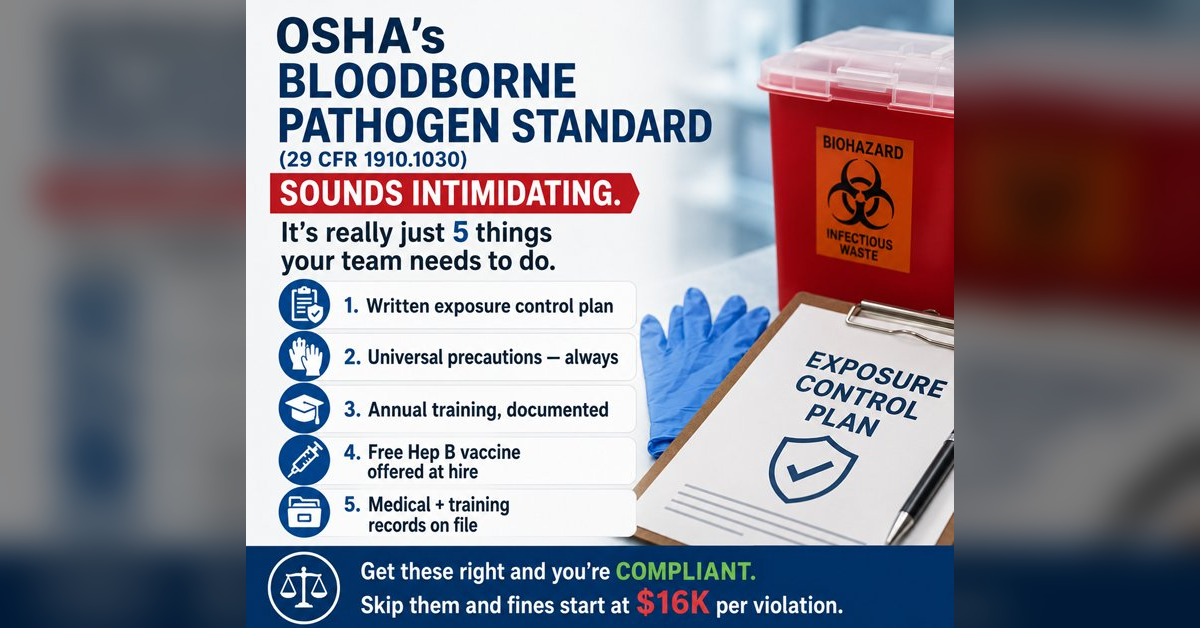
OSHA’s Bloodborne Pathogen Standard, Explained in Plain English
29 CFR 1910.1030 sounds like a bureaucratic nightmare. It’s actually five clear requirements. Here’s what each one means for your team — and why getting it wrong starts at $16,131 per violation.
If you’ve ever Googled “29 CFR 1910.1030” and immediately clicked away, you’re not alone. OSHA’s bloodborne pathogen standard reads like it was written for federal attorneys — not the clinic manager trying to keep her team safe and her facility out of trouble.
But here’s the thing: the standard itself isn’t complicated. It’s five requirements. Clear ones. The confusion comes from the regulatory language layered on top.
This guide cuts through that language. We’ll tell you exactly what 29 CFR 1910.1030 requires, who it applies to, what violations actually cost, and how a proper medical waste and sharps disposal program supports your compliance posture — not just in the abstract, but operationally.
“The goal of the standard is simple: protect workers from exposure to bloodborne pathogens. The documentation requirements exist so employers can prove they’re actually doing it.”
— Amergy Disposal Compliance Team
What Is OSHA’s Bloodborne Pathogen Standard?
The Occupational Safety and Health Administration enacted 29 CFR 1910.1030 in 1991. Its purpose was direct: reduce occupational exposure to pathogens transmitted through blood and other potentially infectious materials (OPIM) — including HIV, Hepatitis B (HBV), and Hepatitis C (HCV).
The standard places legal obligations on employers, not employees. If your workers face a reasonable chance of coming into contact with blood or OPIM on the job, you’re responsible for the controls, training, documentation, and vaccination programs the standard requires.
Since its passage, OSHA has updated the standard through the Needlestick Safety and Prevention Act of 2000, which strengthened requirements around safer needle devices and employee involvement in selecting engineering controls. The core framework, however, has remained consistent for over three decades.
Who Does 29 CFR 1910.1030 Apply To?
The standard uses a specific phrase: “reasonably anticipated” exposure. If blood or OPIM exposure is a foreseeable part of the job — even occasionally — the standard applies. This covers a wide range of industries, including:
- Healthcare workers — nurses, physicians, phlebotomists, dental staff, surgical technicians
- Emergency responders — EMTs, paramedics, firefighters, law enforcement officers
- Tattoo artists and body piercers
- Janitorial and housekeeping staff in clinical or public-health settings
- Funeral home and mortuary professionals
- Medical waste and sharps disposal personnel
- Research laboratory workers handling human blood samples
- Home health aides providing in-home patient care
Company size is irrelevant. A solo-practice physician and a 1,000-bed hospital system are held to the same standard. What matters is whether occupational exposure is reasonably anticipated — not how many employees you have.
The 5 Core Requirements of 29 CFR 1910.1030
Every OSHA inspection, every audit, every violation finding traces back to one of these five pillars. Know them well.
Every covered employer must maintain a written Exposure Control Plan — not a template downloaded from the internet, but a document that reflects your specific facility, your specific job roles, and your specific procedures. Your ECP must:
- Identify all job classifications and specific tasks where exposure occurs or may occur
- Describe methods of implementation for all controls and protective measures
- Be reviewed and updated at minimum annually — and any time tasks or procedures change
- Be accessible to every employee during every work shift
- Include documentation of the annual review of commercially available safer needle devices
If an OSHA compliance officer walks in unannounced and asks for your ECP, you need to produce a current, facility-specific document within minutes. “We have one somewhere” is not a compliant answer — and a generic PDF downloaded from a compliance website will be flagged immediately.
Universal precautions is a simple concept with absolute application: treat every blood sample, every bodily fluid, every OPIM as though it is infectious — regardless of the patient’s known status, regardless of how minor the task appears.
This translates directly to personal protective equipment (PPE) requirements that employers must provide, free of charge, in appropriate sizes:
- Gloves — required whenever contact with blood or OPIM is possible
- Face and eye protection — required when splashing, spraying, or spattering is a risk
- Protective clothing — gowns or lab coats when full-body exposure is possible
- Resuscitation devices — to eliminate direct mouth-to-mouth contact
PPE is not optional — even when employees find it inconvenient. If a worker skips gloves during a blood draw because “it slows them down,” that’s a compliance violation and a liability event. Employers must not only provide PPE but ensure it’s consistently used.
Engineering controls are physical or mechanical safeguards that eliminate or minimize exposure at the source — before it reaches the worker. Work practice controls change how tasks are performed to reduce risk. Both are required; neither alone is sufficient.
Engineering controls examples:
- Sharps containers — puncture-resistant, leak-proof, closeable, properly labeled, and accessible at the point of use
- Safety-engineered needles and scalpels with retractable or shielded mechanisms
- Biohazard bags and containers for contaminated materials
Work practice controls examples:
- No two-handed needle recapping — use a one-handed scoop technique or a safety device
- No eating, drinking, or applying cosmetics in exposure-risk areas
- Thorough handwashing immediately after removing gloves
- Designated contaminated laundry handling procedures
Your sharps disposal program is a direct engineering control requirement. Compliant, properly sized sharps containers from a licensed provider — placed at the point of use, routinely serviced — are not optional upgrades. They are required infrastructure.
Employers must offer the Hepatitis B vaccination series — at no cost to the employee — to all workers with occupational exposure. The standard is specific about timing and process:
- Must be offered within 10 working days of initial assignment to an exposure-risk role
- Must be offered after bloodborne pathogen training is completed
- Must be offered regardless of whether the employee believes they’ve been previously vaccinated
- Declining employees must sign OSHA’s specific declination form — and can change their mind later
- Post-exposure follow-up evaluation must also be made available after any incident
Employees can decline. They can waive their right in writing. But if you never formally offered the vaccine — or if you offered it but have no documentation — you are non-compliant. The offer and the response must both be on file.
This is the requirement most organizations underestimate — and the one that generates the most violations during OSHA inspections. If you don’t have documentation, you don’t have compliance.
- Annual training required for all employees with occupational exposure
- Initial training must occur at or before the time of first exposure-risk assignment
- Training records (dates, attendees, trainer credentials, content summary) kept for 3 years minimum
- Medical records (vaccination, post-exposure evaluation) kept for duration of employment plus 30 years
- Sharps injury log maintained — confidential, but accessible to OSHA upon request
Documentation is your defense in every OSHA audit. A verbal confirmation that training happened is worthless. A sign-in sheet without a training outline is insufficient. If an incident leads to a workers’ compensation claim, those records also become your legal defense in litigation.
What Does Non-Compliance Actually Cost?
Fines are one dimension of the cost. The others — litigation, workers’ compensation claims, reputational damage, and the human cost of a preventable infection — are often far larger. But start with the regulatory numbers.
| Violation Type | Per-Violation Fine | Description | Common Triggers |
|---|---|---|---|
| Other-Than-Serious | Up to $16,131 | Indirect link to serious injury or death | Minor documentation gaps |
| Serious | Up to $16,131 | Substantial probability of serious harm | Missing ECP, no PPE provided |
| Willful | Up to $161,323 | Employer knew and ignored the hazard | Repeated cited violations |
| Repeated | Up to $161,323 | Same standard cited within 5 years | Prior violations not corrected |
| Failure to Abate | Up to $16,131/day | Not correcting a cited violation | Ignoring abatement deadlines |
These fines are assessed per violation — not per inspection. A single OSHA visit to a facility without a compliant ECP, inadequate sharps containers, and no documented training could generate three separate violations totaling nearly $50,000 before any willful multipliers apply.
And that’s before factoring in the litigation exposure if an employee contracts HIV or Hepatitis B due to inadequate workplace controls.
How Amergy Disposal Supports Your Compliance Program
Compliance with 29 CFR 1910.1030 doesn’t happen in isolation. The engineering controls and work practice controls it requires — sharps containers, biohazard packaging, contaminated material handling — all depend on having the right infrastructure in place and serviced consistently.
That’s precisely where Amergy Disposal operates. Our services are designed to fill the compliance gaps that generate the most violations:
- Compliant sharps containers — Available in all standard sizes, meeting OSHA’s puncture-resistance and labeling requirements
- Scheduled or on-demand medical waste pickup — Reliable service cycles that keep containers from overfilling — a citation-generating event in its own right
- DOT and OSHA-compliant packaging and labeling — Biohazard bags, transport containers, and manifests that meet both state and federal requirements
- Documentation and waste manifests — Records that directly support your recordkeeping obligations under the standard
- Compliance guidance — Container placement strategy, waste stream segregation, and best-practice recommendations from a team that works with OSHA standards daily
When your sharps and medical waste program runs correctly, it’s not just good practice — it’s documented evidence that you are meeting the engineering control requirements of 29 CFR 1910.1030. That documentation matters during audits, inspections, and incidents alike.
Is Your Facility’s Compliance Program Audit-Ready?
Don’t wait for an OSHA inspection to discover the gaps. Our compliance team works with healthcare facilities, first responders, tattoo studios, and other covered employers across the U.S. to build compliant, cost-effective medical waste programs.
Frequently Asked Questions
These are the questions compliance managers, practice administrators, and small business owners ask us most often about 29 CFR 1910.1030.
Yes — and this surprises many small practice owners. The standard applies based on the nature of occupational exposure, not company size. A solo-practice physician, a two-chair dental office, and a single-artist tattoo studio are all covered if blood exposure is reasonably anticipated. There is no small business exemption in 29 CFR 1910.1030.
At minimum, annually. But the standard also requires updates whenever new tasks or job classifications are added, procedures change, or new technology (including safer needle devices) becomes available. An annual review date stamped on a document that hasn’t actually changed in five years is a red flag during inspections.
Yes. Employees have the right to decline. However, they must sign OSHA’s specific declination statement — a form that confirms they were offered the vaccine, understand the risks of HBV infection, and are choosing to decline at this time. If they later change their mind, you must make the vaccine available again. The cost is always on the employer.
Two retention requirements apply. Medical records — including vaccination documentation, post-exposure evaluations, and related correspondence — must be retained for the duration of employment plus 30 years. Training records — including dates, content covered, trainer credentials, and employee sign-in — must be kept for a minimum of 3 years. These records must be kept separate from general personnel files.
An exposure incident under 1910.1030 involves specific, eye, mouth, mucous membrane, non-intact skin, or parenteral contact with blood or OPIM. It triggers a mandatory post-exposure evaluation and follow-up protocol. A near-miss — where a needlestick almost occurred but didn’t — should still be documented internally and reviewed for engineering control improvements, but it does not trigger the formal post-exposure evaluation requirement.
Yes. OSHA requires sharps containers to be located as close as feasible to the area where sharps are used. A single container in a break room down the hall does not satisfy this requirement for an exam room where blood draws occur. Containers must also be maintained upright, not overfilled beyond the fill line, and replaced routinely — not only when full.
The Bottom Line
OSHA’s bloodborne pathogen standard is not a bureaucratic obstacle. It’s a straightforward framework — five requirements built around a single goal: protect workers from preventable infections.
The organizations that struggle with compliance aren’t typically the ones that don’t care. They’re the ones that have the right intentions but lack the infrastructure, documentation habits, or operational systems to back those intentions up when an inspector or incident forces the question.
Close the gap before it closes you. A proper exposure control plan, reliable PPE, compliant sharps containers serviced on a consistent schedule, annual documented training, and a vaccine offer program on file — these aren’t aspirational goals. They’re the minimum standard.
At Amergy Disposal, we help facilities across the United States build medical waste and sharps disposal programs that don’t just check a box — they become a genuine part of your compliance infrastructure. If you’re not certain where your program stands, that’s exactly the conversation to have before your next OSHA inspection.
Ready to Build a Compliant Waste Program?
Serving healthcare facilities, first responders, dental practices, tattoo studios, and more across all 50 states. Let’s make sure your compliance infrastructure is ready for any audit.