
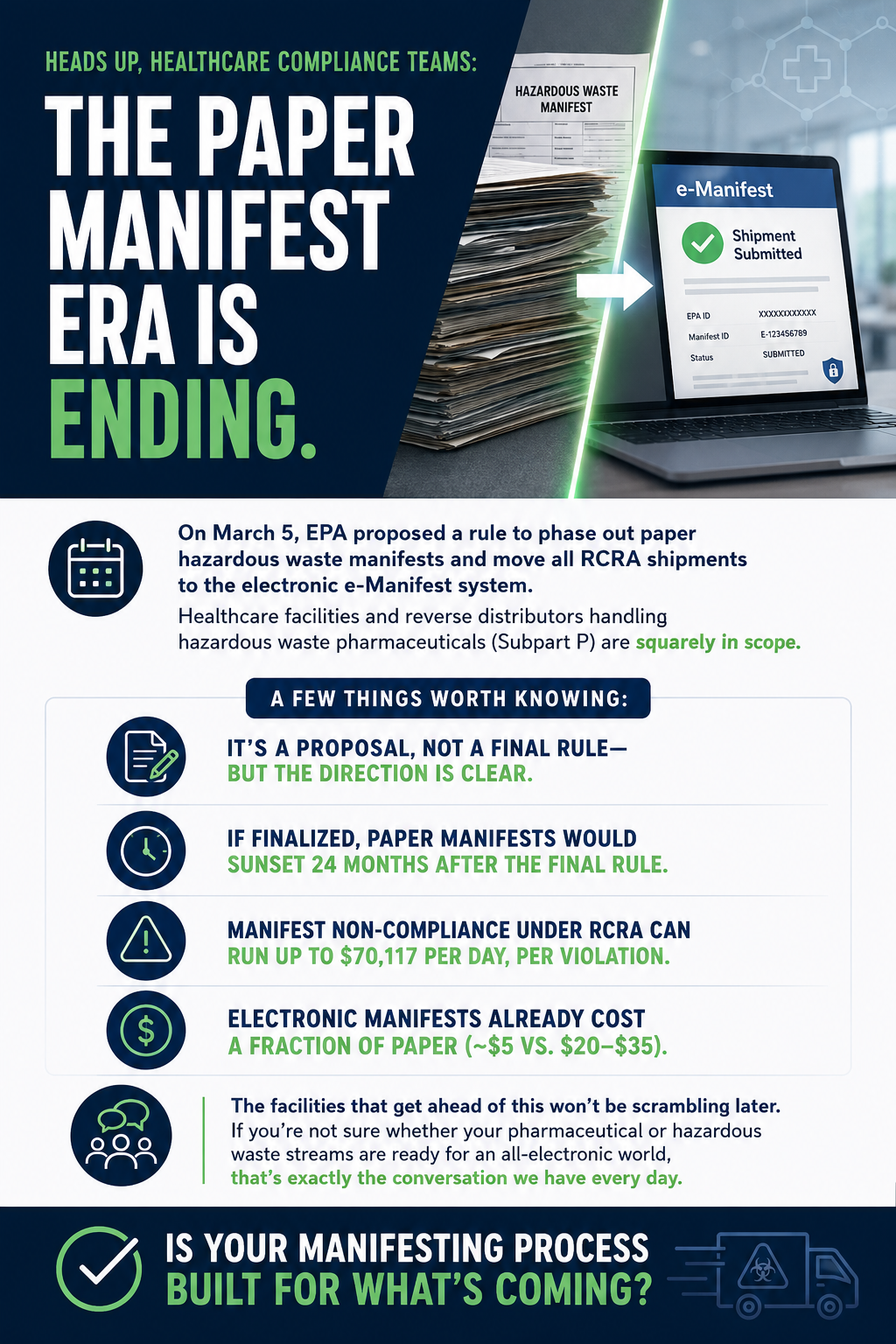
Since the EPA’s e-Manifest system launched in 2018, electronic manifests have accounted for less than 1% of all manifests submitted. The agency now wants to close that gap for good — and its proposed EPA paper manifest sunset rule would end paper hazardous waste manifests entirely. For hospitals, clinics, laboratories, and any facility shipping hazardous waste off-site, this is a shift worth preparing for today.
What is the EPA paper manifest sunset rule?
On March 5, 2026, the Environmental Protection Agency issued a proposed rule to phase out — or “sunset” — paper hazardous waste manifests and require waste handlers to use the electronic hazardous waste manifest (e-Manifest) system for every shipment regulated under the Resource Conservation and Recovery Act (RCRA).
Under the proposal, once a final rule is published, facilities would have a 24-month runway before the paper cutoff takes effect. After that compliance date, EPA would no longer accept paper manifests — only fully electronic or hybrid manifests would be permitted. The public comment period on the proposed rule (Docket ID No. EPA-HQ-OLEM-2025-3456) closed on May 4, 2026, and the rule now awaits EPA’s final determination.
Why the e-Manifest rule matters for healthcare facilities
It’s a common misconception that this only affects heavy industry. The proposed rule specifically names healthcare facilities and reverse distributors subject to RCRA’s hazardous waste pharmaceutical requirements (Subpart P) among the regulated parties.
If your facility ships any of the following off-site for treatment or disposal, a hazardous waste manifest is required — which puts you directly in scope:
- Hazardous waste pharmaceuticals, including RCRA-listed drugs such as warfarin, nicotine products, and certain antineoplastic (chemotherapy) agents
- Chemotherapy and other hazardous drug waste
- Mercury-containing equipment such as thermometers and blood pressure devices
- Solvents, formaldehyde, and other listed chemical wastes common in labs and clinical settings
Your specific obligations depend on your generator status — Large Quantity Generator (LQG), Small Quantity Generator (SQG), or Very Small Quantity Generator (VSQG) managing episodic events. But the direction is the same across the board: the regulated community is moving toward mandatory electronic manifesting.
The cost and compliance stakes
Two numbers make the case for getting ahead of this rule.
Beyond direct fines, manifest violations can trigger facility audits, permit complications, and reputational damage — all far more costly than the investment required to get compliant.
Fully electronic vs. hybrid manifests
The rule allows two compliant paths, and understanding the difference matters for your recordkeeping:
Fully electronic manifests
Created, signed, and stored entirely within EPA’s RCRAInfo portal. Every handler — generator, transporter, and receiving facility — signs digitally. This is the cleanest option and delivers real-time tracking visibility that paper simply can’t.
Hybrid manifests
These begin with a paper signature but are treated as electronic manifests for regulatory and fee purposes. One important catch: the generator’s initial signed paper copy is not uploaded to e-Manifest and must be retained at your facility for the full three-year recordkeeping period.
What healthcare facilities should do now
Whether or not the rule is finalized on EPA’s expected timeline, these steps reduce risk and prepare your facility for an all-electronic future:
- Register in RCRAInfo. SQGs and LQGs should maintain an account and designate at least one — ideally two — authorized site managers to sign and certify manifests electronically.
- Verify your transporter is registered. If your hauler isn’t set up in the e-Manifest system, electronic completion becomes impossible.
- Confirm your waste codes are accurate. Incorrect codes create discrepancies between your manifest and the receiving facility’s records — a frequent audit trigger.
- Follow up on open manifests. Track any manifest not signed by the receiving facility within 35 days so you don’t miss the exception report deadline.
- Treat this as compliance, not just IT. e-Manifest is a regulatory obligation, not a software rollout to hand off and forget.
- Run a department-by-department waste review. Identify each stream — regulated medical waste, sharps, hazardous waste pharmaceuticals, chemical hazardous waste — and match it to the correct container, label, storage rule, and record.
Not sure if your facility is ready?
Amergy helps healthcare facilities manage regulated medical waste, hazardous waste pharmaceuticals, and the compliance paperwork that comes with them — so staying ahead of shifts like the paper manifest sunset rule is one less thing on your plate.
Talk to a Compliance SpecialistFrequently asked questions
Is EPA e-Manifest mandatory for all medical waste in 2026?
No. EPA e-Manifest applies to hazardous waste shipments that require a manifest. It does not cover every type of regulated medical waste, and it does not automatically apply to every red bag or sharps container.
When will paper manifests be eliminated?
The proposed rule sets the paper-manifest sunset at 24 months after a final rule is published — not 24 months after the March 2026 proposal. The exact date depends on when EPA finalizes the rule.
What are the penalties for manifest non-compliance?
RCRA civil penalties for serious or willful manifest violations can reach up to $70,117 per day, per violation. State environmental agencies may impose additional penalties.
Which facilities are affected by the proposed rule?
Large and small quantity generators, certain very small quantity generators managing episodic events, hazardous waste transporters, treatment and disposal facilities, and healthcare facilities and reverse distributors subject to the hazardous waste pharmaceutical (Subpart P) requirements.
This article is provided for general informational purposes and reflects the status of EPA’s proposed rule as of July 2026. It is not legal or regulatory advice. Facilities should consult their compliance team or a qualified provider for guidance specific to their operations and state requirements.