
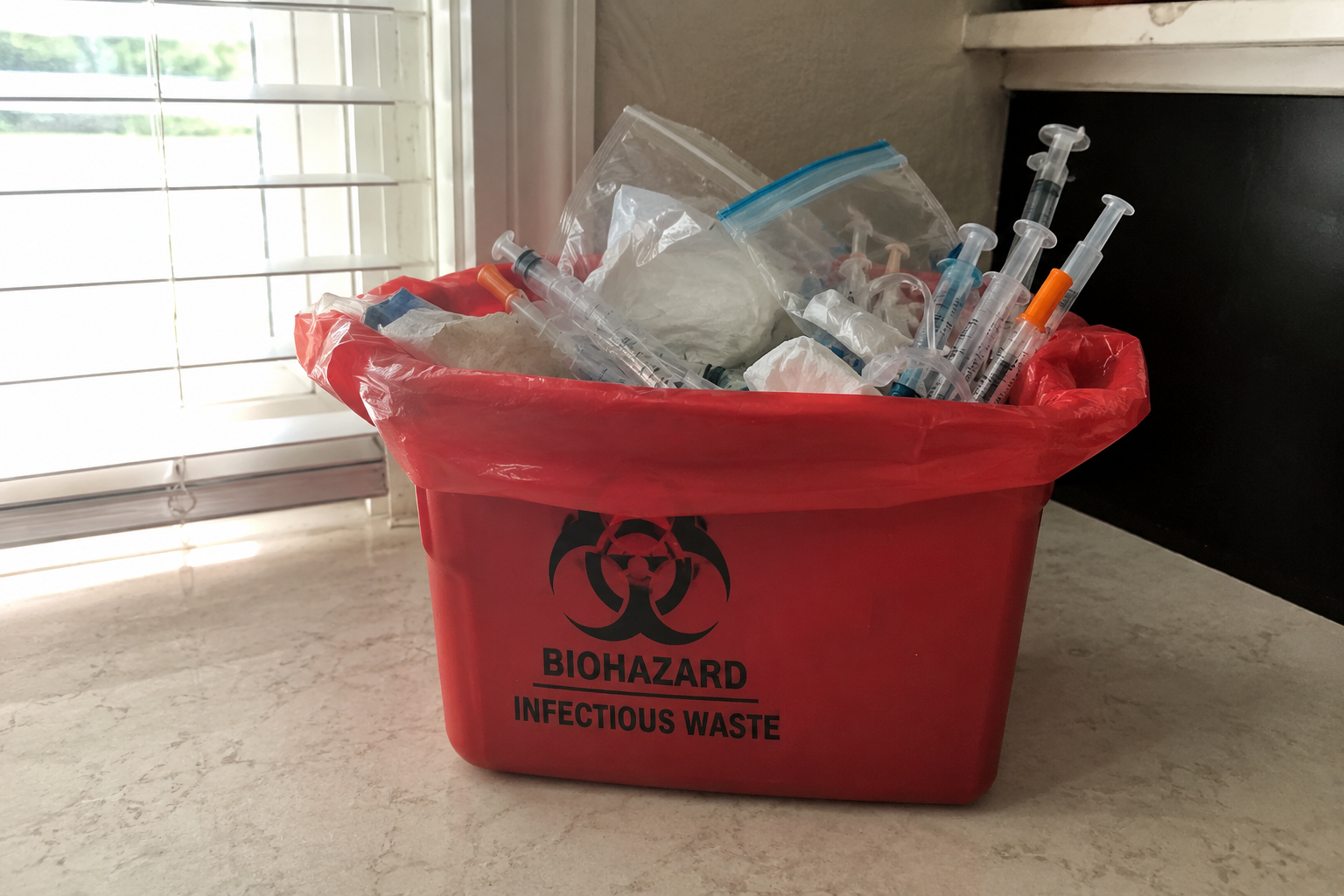
Home Healthcare Waste: America’s Fastest-Growing Disposal Crisis
As care moves from hospital corridors into living rooms, a massive — and largely unregulated — wave of biohazardous waste follows. Here’s what every provider, patient, and home health agency needs to know in 2026.
Home healthcare market projected by 2032
Sharps discarded annually outside clinical settings
Max EPA fine per day, per violation
Separate state regulatory frameworks to navigate
The Home Healthcare Boom — and Its Hidden Byproduct
The American healthcare system is in the middle of a quiet revolution. Driven by an aging population, cost pressures on hospitals, advances in portable medical technology, and the hard lessons of a global pandemic, care is rapidly decentralizing — moving out of clinical facilities and into patients’ homes, assisted living communities, retail clinics, and community sites at an unprecedented pace.
The numbers are striking. The U.S. home healthcare market is projected to reach $176 billion by 2032, driven by demand for in-home infusions, wound care, dialysis, insulin management, oncology support, and chronic disease monitoring. Millions of Americans now self-administer injectable medications — from insulin and blood thinners to biologic drugs for rheumatoid arthritis and multiple sclerosis.
But there is a side of this healthcare revolution that receives almost no public attention: what happens to the waste these patients generate?
Every injection leaves a used syringe. Every infusion generates contaminated tubing. Every diabetic patient produces lancets. Every cancer patient receiving home chemotherapy creates highly hazardous pharmaceutical waste. And unlike a hospital — where trained environmental services teams, licensed haulers, and strict protocols govern every red bag — the average home has no infrastructure, and no mandate, to handle any of it safely.
“The disease-causing potential of medical waste is greatest at the point of generation. In a hospital, that point is surrounded by safety protocols. In a home, it is not.” — U.S. Environmental Protection Agency, Medical Waste Program
At Amergy Disposal, we work with home health agencies, hospice providers, clinics, and laboratories across all 50 states. What we see on the ground confirms what the data shows: the volume of unmanaged, improperly disposed home healthcare waste is growing — and the consequences, both for public health and for compliance, are significant.
What Counts as Home Healthcare Waste?
Before we can solve the problem, we need to name it clearly. Home healthcare waste — sometimes called “home-generated medical waste” or HGMW — encompasses any waste generated during medical care delivered or self-administered in a residential setting. This includes:
Needles, syringes, lancets, auto-injectors (e.g., EpiPens), and IV catheters. Estimated 3+ billion are discarded annually in the U.S. outside of clinical settings.
Unused or expired prescription drugs, including controlled substances, biologics, and chemotherapy agents — many classified as hazardous under RCRA.
Blood-soaked gauze, wound dressings, ostomy supplies, dialysis waste, and other materials contaminated with potentially infectious body fluids.
Tubing, gloves, empty bags, and other materials in contact with antineoplastic drugs administered at home — among the most hazardous waste streams in existence.
Batteries from portable medical devices, glucose monitors, and infusion pumps — a growing concern as lithium battery waste enters the regulatory spotlight in 2026.
Certain medical-grade materials containing “forever chemicals,” now subject to new EPA interim guidance on proper disposal and destruction.
The Public Health Risks Nobody Is Talking About
The consequences of improper home medical waste disposal are not theoretical. They are playing out right now in landfills, sewer systems, waterways, and emergency rooms across the United States.
Needlestick injuries in sanitation workers
When used syringes are tossed into household trash, they create an invisible hazard for the sanitation workers who handle that waste. According to the EPA, improperly discarded sharps cause needlestick injuries when containers break open inside garbage trucks or when needles are accidentally sent to recycling facilities. These injuries carry a real risk of bloodborne pathogen transmission — including Hepatitis B, Hepatitis C, and HIV.
Waterway contamination from flushed medications
For decades, the most common consumer guidance for unused medications was to flush them down the toilet. We now know this was wrong. Pharmaceuticals in waterways — from antibiotics to hormones to chemotherapy agents — have been detected in drinking water sources and are linked to antibiotic resistance, endocrine disruption in aquatic life, and long-term ecological harm. Yet millions of Americans still flush medications because they have no better option available.
Community exposure to hazardous waste in landfills
Chemotherapy drugs, antiviral medications, and controlled substances placed in household trash end up in municipal solid waste landfills — facilities not designed to contain or neutralize hazardous pharmaceutical compounds. Leachate from these landfills can contaminate soil and groundwater, disproportionately impacting lower-income neighborhoods located near waste facilities.
Infection risk from improperly stored biohazardous materials
Blood-soaked materials and other infectious waste stored in unsecured household trash create vectors for pathogen transmission — not just for sanitation workers, but for children, pets, and others who come into contact with residential waste before collection.
The CDC notes that although any item that has had contact with blood, exudates, or secretions may be potentially infectious, safe handling requires proper containment from the very moment of generation — a standard that residential settings routinely fail to meet without intentional systems in place.
Home health is one of the fastest-growing sectors we serve, and the waste compliance gap is real. Agencies that assume household disposal rules apply to their clinicians in the field are taking on serious regulatory and liability exposure. The good news is that the right partner — with the right systems — makes compliance straightforward, not a burden.
The Regulatory Patchwork: Federal vs. State
Here is where home healthcare waste gets legally complex — and where providers, agencies, and patients face real liability exposure.
Unlike hospital-generated regulated medical waste, which is subject to robust federal oversight from OSHA, the EPA, and the Department of Transportation, household-generated medical waste falls largely outside federal jurisdiction. The EPA has not had specific statutory authority over medical waste since the Medical Waste Tracking Act of 1988 expired in 1991. After that expiration, states assumed the regulatory role — resulting in 50 different sets of rules with very different standards, penalties, and requirements.
However, the picture changes significantly when a licensed home health agency is involved. In most states, if a healthcare professional from a licensed agency administers an injection in a patient’s home, the resulting sharps are legally classified as medical waste — and must be transported back to the agency and disposed of through a proper medical waste management system. They cannot simply be left in the patient’s trash.
For self-injecting patients or family caregivers acting independently, rules are more permissive — but still vary enormously by state:
One of the strictest frameworks in the nation. The Medical Waste Management Act governs home-generated sharps. Manufacturer-funded mail-back and take-back programs are required by law. A major stewardship organization announced program termination in June 2026, creating a critical compliance gap.
Home health agencies are treated as healthcare-related facilities; their waste must be managed as medical waste. Self-injecting patients may encapsulate sharps in a hard matrix before trash disposal. Amergy serves Texas providers statewide.
Revised the legal definition of “medical waste” in July 2025 to clarify what materials require regulated treatment — providing more certainty for home health providers operating in the state.
Implemented a sweeping two-phase regulatory update in 2025, overhauling waste classification and introducing new registration and permitting requirements for all waste generators.
Pathological and sharps waste must be incinerated, autoclaved, or inactivated through approved methods. Fines for non-compliance range from $1,000 to $25,000 per day.
A draft update to infectious waste regulations is expected in 2026, following a preliminary public hearing in January 2025. Home health providers in Wisconsin should watch this space closely.
2026 Compliance Updates You Must Know
The regulatory environment governing medical waste — including home healthcare waste — is shifting in 2026. Here are the developments every provider, agency, and compliance officer must be tracking right now.
EPA’s proposed paper manifest phaseout
On March 5, 2026, the EPA published a formal proposal to phase out paper hazardous waste manifests and transition fully to the e-Manifest electronic system. While this is a proposal rather than a final rule — and the actual sunset date will come 24 months after finalization — facilities should begin preparing their digital infrastructure immediately. Home health agencies that handle hazardous pharmaceutical waste will be directly affected.
PFAS legislation and disposal guidance
Senator Richard Durbin’s Forever Chemical Regulation and Accountability Act of 2026 proposes a national framework for phasing out non-essential PFAS uses. Separately, the EPA has released 2026 interim guidance on destruction and disposal of PFAS-containing materials — relevant to home health providers managing specialty medical supplies and lab-adjacent waste streams.
Digital waste tracking momentum
By late 2026, many jurisdictions are expected to mandate electronic reporting for regulated medical waste — replacing paper documentation with real-time, cloud-based tracking from generation through final disposal. For home health agencies managing distributed waste across dozens or hundreds of patient homes, this transition will require new systems and qualified vendor partnerships like Amergy Disposal.
The 2026 regulatory environment is the most active I have seen in years. Between the EPA’s proposed e-Manifest rule, state-level definition updates, and PFAS guidance, home health agencies that are not proactively reviewing their waste protocols are falling behind. Compliance is not a one-time checkbox — it is an ongoing operational commitment, and agencies need a partner who understands the full picture across all 50 states.
Lithium battery waste
As portable medical devices proliferate in home settings, the EPA is advancing proposals to classify lithium-ion batteries as federal universal waste. This simplified classification would make compliance more manageable for home health agencies — but also introduces new labeling and collection requirements on the horizon.
California’s sharps stewardship gap
On January 26, 2026, The Drug Takeback Solutions Foundation — one of California’s two manufacturer-funded stewardship organizations — announced it would terminate its home-generated sharps waste disposal program effective June 30, 2026. California providers and agencies must identify compliant alternative disposal channels before that deadline. Amergy Disposal serves California clients statewide and can bridge this gap.
Solutions: What Providers and Patients Can Do Now
Effective, compliant solutions for home healthcare waste exist today. The challenge is education, access, and having the right operational infrastructure — all areas where Amergy Disposal partners directly with home health agencies across the country.
For home health agencies and providers
- Establish a formal waste return program: Require staff to transport used sharps and other regulated medical waste back to the agency for proper disposal — legally required in most states when a licensed provider delivers care in the home.
- Partner with a licensed medical waste vendor experienced in distributed waste collection from home-based settings, not just clinical facilities. Amergy Disposal provides electronic manifesting, scheduled pickups, and certificates of destruction across all 50 states.
- Train all home health staff annually on waste identification, segregation, container use, and state-specific disposal rules. Document every session — OSHA requires it, and Amergy offers both online and in-person compliance training including BBP, HIPAA, DOT, and HazCom.
- Provide patients with FDA-cleared sharps disposal containers and written instructions at the start of every service engagement. Amergy’s mail-back programs make this seamless — kits come pre-labeled with return shipping materials and meet USPS, DOT, and OSHA guidelines.
- Develop a written home healthcare waste management policy and review it whenever regulations change. Amergy provides access to current regulations and waste plan support for all clients.
- For chemotherapy patients: treat all materials that contact antineoplastic drugs as hazardous waste — a federal RCRA requirement that applies regardless of the care setting.
For patients and family caregivers
- Never place loose needles, syringes, or lancets in household trash or recycling. Use an FDA-cleared sharps disposal container — available at most pharmacies — and return it via a mail-back program or community collection site.
- Return unused or expired prescription medications to a DEA-authorized take-back location or event, not the trash or toilet.
- Ask your home health agency what their waste return policy is. A reputable agency — like those that partner with Amergy Disposal — will have a clear, documented answer.
- Check your state’s rules via CalRecycle (California), TCEQ (Texas), or your state health department website for household medical waste guidance specific to your location.
The Road Ahead: Digital Tracking and National Standards
Regulators, public health advocates, and industry leaders are beginning to align around a vision for the future of home healthcare waste management — one that combines technology, extended producer responsibility, and national minimum standards to replace today’s patchwork of inconsistent state rules.
Digital waste tracking represents the most significant structural shift on the horizon. Real-time, cloud-based tracking from the point of generation through final disposal would transform compliance for home health agencies managing waste across hundreds of patient homes, and create the audit trails that regulators, insurers, and accreditation bodies increasingly require. Amergy Disposal is already investing in digital documentation tools to prepare our clients for this transition.
Extended producer responsibility models — where pharmaceutical and device manufacturers fund take-back and disposal programs — are gaining legislative traction beyond California. As the home healthcare market grows, manufacturers will face increasing pressure to account for the full lifecycle of their products, including the waste they generate in patients’ homes.
“Health care waste adversely affects society in ways that have been overlooked for decades. With limited federal tracking and lack of regulation, patterns of environmental harm persist — and communities of color and low-income communities most often bear the greatest burden.” — American Public Health Association, Policy Statement on Health Care Waste (2023)
At the federal level, momentum is building toward national minimum standards for home-generated medical waste — particularly sharps. The current state-by-state patchwork creates real inequities: patients in states with strong programs have safe, accessible disposal options, while patients in states without them do not. A federal baseline would level the playing field, protect the public, and reduce the compliance burden on agencies that operate across multiple states.
Key Takeaways and Action Steps
Home healthcare waste is not a niche compliance issue. It is a mainstream public health challenge that will define how home health agencies operate over the next decade. Here is what matters most heading into the rest of 2026:
- Audit your current waste return and disposal process for every active patient in every state you operate
- Verify your medical waste vendor is licensed, uses electronic manifesting, and provides certificates of destruction
- Update staff training to reflect 2025–2026 regulatory changes — Amergy provides BBP, HIPAA, DOT, and HazCom training
- Provide sharps containers and disposal instructions to all self-injecting patients at intake
- Begin preparing for EPA’s e-Manifest transition by evaluating your documentation infrastructure now
- California agencies: identify compliant alternatives to the Drug Takeback Solutions Foundation before June 30, 2026
- Review pharmaceutical waste protocols for RCRA hazardous waste compliance, especially for chemotherapy and controlled substance streams
The home healthcare boom is one of the defining healthcare trends of our time. The waste it generates doesn’t have to become one of the defining public health crises. With the right infrastructure, the right training, and the right compliance partner, home health agencies can deliver care where patients want it — safely, compliantly, and without leaving a trail of hazardous waste behind.
Is your home health agency waste-compliant in 2026?
Get a free compliance consultation from a dedicated Amergy account representative. We assess your current program, identify gaps, and build a solution that keeps your agency protected — from fines up to $75,000 per day.
Request a Free Quote → No long-term contracts required · Dedicated account rep assigned · Service in all 50 states