
⚠ Illinois PIMW transporters must not be in transit more than 10 calendar days — and generators are liable the entire time. Is your hauler IEPA-permitted? Get a free Amergy compliance check →
Illinois Medical Waste Disposal:
What PIMW Rules Mean for Your Business
Illinois uses a unique term — “Potentially Infectious Medical Waste” — and enforces some of the most layered compliance requirements in the Midwest. Fortunately, staying compliant doesn’t have to be complicated when Amergy Disposal serves all 102 Illinois counties.
Illinois Medical Waste Disposal: The PIMW Rules Every Generator Must Understand
A Different Term, A Different Framework
When it comes to Illinois medical waste disposal, the very first thing businesses must understand is the terminology. Illinois does not use the term “medical waste” or “biohazardous waste” in its primary regulatory framework. Instead, the state uses the term “Potentially Infectious Medical Waste” (PIMW) — governed by Title XV of the Illinois Environmental Protection Act (415 ILCS 5/56) and the detailed operational rules in 35 Illinois Administrative Code (IAC), Subtitle M, Parts 1420–1422. This distinction matters enormously, because businesses relying on guidance from other states frequently miss PIMW-specific provisions that apply directly to their Illinois operations.
Moreover, Illinois’ regulatory framework is administered jointly by the Illinois Environmental Protection Agency (IEPA) and the Illinois Pollution Control Board (IPCB) — making it one of the most layered compliance environments in the Midwest. As a result, generators face obligations that span multiple agencies and multiple regulatory codes simultaneously. Amergy Disposal helps Illinois businesses navigate every layer of this framework, statewide across all 102 counties.
Who This Guide Is Written For
This comprehensive guide is written for any Illinois business that generates PIMW and any business that generates, stores, transports, or disposes of PIMW in the Prairie State. That includes — but is not limited to — hospitals, dental offices, urgent care centers, veterinary clinics, research laboratories, dialysis centers, pharmacies, acupuncture clinics, nursing homes, and funeral homes. Furthermore, it covers the specific IEPA and IPCB rules your facility must follow, the financial penalties for non-compliance, and how partnering with Amergy Disposal reduces both cost and compliance risk at the same time.
🔑 Focus Keyphrase for This Page
Throughout this guide, we address Illinois medical waste disposal compliance under IEPA PIMW regulations. Use the table of contents in the sidebar to jump to the section most relevant to your facility.
What Is PIMW? Understanding Illinois’ Medical Waste Definition
Illinois’ Official PIMW Definition
Under 35 IAC 1420.102, Potentially Infectious Medical Waste (PIMW) is defined as waste generated in connection with the diagnosis, treatment, or immunization of human beings or animals; research pertaining to the provision of medical services; or the provision or testing of biologicals. Because this definition is broader than many business owners initially expect, understanding exactly what it covers is therefore the essential first step toward full IEPA PIMW compliance under state law.
Illinois’ Six PIMW Categories
Specifically, IEPA regulations recognize the following categories of PIMW:
- Cultures and stocks — infectious agents and associated biologicals from laboratories and research
- Human pathological waste — tissues, organs, body fluids, body parts, and specimens
- Human blood and blood products — including items saturated with free-flowing blood
- Used sharps — needles, syringes, and blades used in patient care, research, or laboratory work
- Selected isolation wastes — from patients with highly communicable diseases
- Animal research waste — from animals inoculated with infectious agents
Determining Your Compliance Obligations
Notably, Illinois requires every potential generator to first conduct an applicability determination — that is, confirming whether your waste actually meets the PIMW definition before pursuing compliance. Consequently, businesses that skip this step may either over-comply (wasting money) or under-comply (risking fines). Additionally, the rules include specific exceptions for household-generated waste and certain research materials. When in doubt, therefore, consulting an IEPA compliance specialist — or contacting Amergy for a free assessment — is always the safest course of action.
⚡ Illinois-Specific Insight
Unlike most states, Illinois requires generators to make a formal “applicability determination” before pursuing compliance. This self-assessment process — documented in writing — protects your business from both over-regulation and unintentional non-compliance with Illinois medical waste disposal rules.
Illinois PIMW Laws & IEPA Requirements: A Plain-English Breakdown
The Primary Governing Statutes
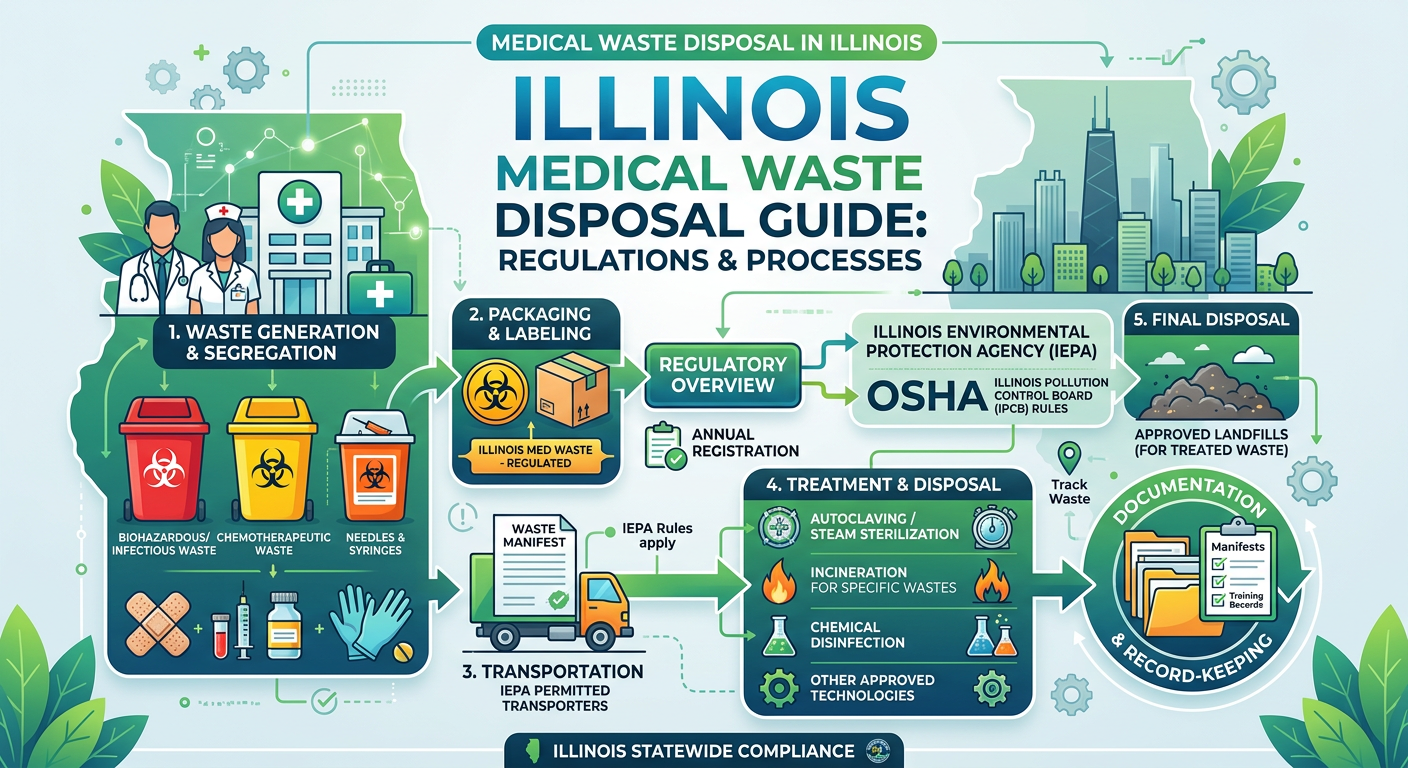
All PIMW activity in Illinois is governed by Title XV of the Illinois Environmental Protection Act (415 ILCS 5/56) and implemented through 35 IAC, Subtitle M — Parts 1420 (General Provisions), 1421 (Transportation), and 1422 (Facilities). The Illinois Pollution Control Board adopted these regulations on June 17, 1993, and they became effective June 21, 1993. Furthermore, federal OSHA, USDOT/PHMSA, and EPA regulations apply alongside state rules — and both must be followed simultaneously. As a generator, therefore, you are accountable to multiple regulatory layers at once.
Every PIMW Shipment Requires an Illinois-Specific Manifest
The transportation of PIMW in Illinois requires an Illinois-specific PIMW manifest — not a generic medical waste form. The outer package must be marked with the transporter’s name, address, phone number (24-hour if available), and permit number. Furthermore, each PIMW package must include the shipment date or a unique identification number directly corresponding to the initial date of shipment. Generators must retain copies of all PIMW manifests at the storage operation for three years and make them available for inspection and photocopying by IEPA representatives at any time during normal business hours.
How Illinois Law Requires PIMW to Be Stored On-Site
Any person who stores PIMW prior to treatment, disposal, or off-site transport must: store waste in a manner maintaining packaging integrity and protection from water, rain, and wind; maintain waste in a nonputrescent state using refrigeration when necessary; lock all outdoor storage areas to prevent unauthorized access; limit access to authorized employees only; protect waste from animals and prevent breeding grounds for vectors; and never compact PIMW packages or subject them to stress that compromises container integrity. Additionally, multiple generators in the same building may share a common storage area, provided all individual compliance obligations are otherwise met.
Illinois’ Strict 10-Day Transport Rule
One of the most distinctive aspects of PIMW compliance in Illinois is the 10-calendar-day maximum transport rule. PIMW must not be in transport for more than 10 calendar days — a rule that applies from pickup through final delivery to a permitted destination facility. Furthermore, transporters must develop and keep an emergency response plan in their vehicles at all times, submit annual reports to the IEPA, and carry current IEPA permits. Critically, only IEPA-permitted transfer, storage, or treatment facilities may serve as PIMW destinations — PIMW may only be placed in a landfill after proper treatment has eliminated its infectious potential.
Additional IEPA Compliance Requirements
Beyond the major provisions above, comprehensive Illinois medical waste disposal compliance also requires the following from generators:
- Applicability Determination: Before pursuing compliance, every potential generator must first determine whether their waste meets the PIMW definition under 35 IAC 1420.102. This determination must be documented and retained on-site.
- IEPA-Permitted Haulers Only: PIMW may only be transported by haulers holding current IEPA transportation permits. Using an unpermitted transporter exposes your facility to full generator liability for the waste from pickup through final treatment.
- Sharps-Specific Treatment Requirements: Sharps must be treated to eliminate their infectious potential and either rendered unrecognizable through treatment or properly packaged prior to landfill disposal. Standard disposal without treatment is explicitly prohibited.
- Annual Transporter Reporting: IEPA-permitted transporters must submit annual reports to the IEPA. Generators should request and retain copies of their hauler’s most recent annual report as part of their compliance documentation.
- Three-Year Record Retention: All PIMW manifests must be retained on-site for a minimum of three years and must be available for IEPA inspection at any time during normal business hours. The retention period is extended for any manifest that is the subject of ongoing enforcement action.
- USDOT/PHMSA Compliance: Federal DOT regulations under PHMSA may apply to off-site PIMW transportation in Illinois. Consequently, generators must ensure their haulers comply with both federal and state transportation requirements simultaneously.
- Special Waste Requirements: Certain PIMW components may also qualify as Illinois “special waste,” requiring a special waste manifest and a permitted special waste hauler for landfill disposal. Generators must therefore assess each waste stream under both the PIMW and special waste regulatory frameworks.
- Employee Training: All staff handling PIMW must receive documented OSHA Bloodborne Pathogen training (29 CFR 1910.1030) before initial exposure, with annual refreshers. Training records — including attendee names, dates, and topics covered — must be maintained on-site.
- Pharmaceutical Waste: Pharmaceutical and chemical waste components that meet Illinois hazardous waste definitions are separately regulated under 35 IAC, Subtitle G and federal RCRA rules. Flushing or placing regulated pharmaceuticals in ordinary trash is explicitly prohibited.
⚠ Top IEPA Violations in Illinois
IEPA and Illinois Pollution Control Board enforcement actions most frequently involve: (1) using non-permitted transporters, (2) missing or incomplete PIMW manifests, (3) failing to treat sharps before disposal, and (4) exceeding storage standards. Let Amergy review your Illinois medical waste disposal program for free →
Illinois EPA’s Mission & How Amergy Keeps Your Business Aligned
Understanding the IEPA’s Role
The Illinois Environmental Protection Agency (IEPA) is the primary state agency overseeing Illinois PIMW regulation through its Bureau of Land. Notably, the Illinois General Assembly was the first state legislature in the nation to adopt a comprehensive Environmental Protection Act, which was signed into law by Governor Richard Ogilvie and became effective on July 1, 1970. As a result, Illinois has a particularly deep and well-established environmental enforcement tradition.
📋 Official IEPA Mission Statement
“The mission of the Illinois Environmental Protection Agency is to safeguard environmental quality, consistent with the social and economic needs of the State of Illinois, so as to protect health, welfare, property, and the quality of life.”
The IEPA Bureau of Land’s Direct Role
Specifically, the IEPA’s Bureau of Land administers the PIMW program — protecting human health and the environment by regulating the transfer, storage, and disposal of waste and overseeing the cleanup of contaminated properties. In practice, this means Bureau of Land inspectors are authorized to visit facilities, review PIMW manifests, inspect storage areas, and verify transporter permit status — all without prior notice. Furthermore, the Illinois Pollution Control Board — the separate agency that adopts environmental regulations and decides contested enforcement cases — works jointly with IEPA on PIMW standards and penalties. Consequently, enforcement actions can move through two separate agencies simultaneously.
How Amergy Supports the IEPA’s Mission
Every Amergy service in Illinois is built directly around IEPA’s PIMW framework. Specifically, Amergy uses only IEPA-permitted biohazardous waste transporters, generates fully compliant Illinois-specific PIMW manifests for every pickup, ensures all waste reaches IEPA-permitted destination facilities, and provides a 24/7 compliance portal that keeps all records inspection-ready. As a result, when IEPA’s Bureau of Land arrives for an inspection, your documentation is always complete, current, and organized.
The Real Cost of Illinois Medical Waste Disposal Non-Compliance
Penalties Are Severe — and Compound With Every Day
Illinois enforces PIMW regulations through both IEPA inspections and Illinois Pollution Control Board proceedings. Under Section 42 of the Illinois Environmental Protection Act and the penalty factors in 35 IAC 1420.106, civil penalties for PIMW violations in Illinois can reach $50,000 per day per violation. Moreover, each day of continuing non-compliance constitutes an additional, independent violation. Furthermore, RCRA-related violations involving pharmaceutical or hazardous waste carry separate federal maximum penalties that increase annually. As a result, even a brief window of non-compliance can generate catastrophic financial liability in a remarkably short time.
Civil penalties per violation per day under the Illinois Environmental Protection Act and IPCB enforcement authority.
The Illinois Pollution Control Board can initiate separate contested enforcement proceedings independently from IEPA — creating dual agency exposure.
Knowing or willful violations of Illinois PIMW rules may result in criminal prosecution, misdemeanor or felony charges, and imprisonment.
IEPA may immediately revoke a transporter’s permit or a facility’s operating authorization, halting all PIMW-related business operations.
Generators bear full, uncapped personal liability for all cleanup and remediation costs from improperly disposed or abandoned PIMW.
Transporter annual report failures are separately enforceable, and generators who use non-compliant haulers share liability for reporting gaps.
✓ Prevention Costs Far Less Than Any Penalty
A full year of compliant Illinois medical waste disposal service with Amergy costs a fraction of a single day’s IEPA civil penalty. Get your free quote and compliance assessment from Amergy today →
How Illinois Businesses Are Reducing Their Medical Waste Disposal Costs
Why Most Illinois Businesses Overpay
From Advocate Health Care in Chicago to independent dental practices in Peoria and nursing homes in Springfield, Illinois businesses routinely discover that their current biohazardous waste vendor is charging far more than necessary. Hidden fuel surcharges, environmental fees, administrative markups, and auto-renewing contracts with annual price escalations are widespread tactics among large national vendors. Amergy, by contrast, offers transparent all-inclusive pricing — covering PIMW pickup, Illinois-specific manifest generation, compliance portal access, and quarterly reporting data — all in a single flat rate with no hidden fees.
Estimated Monthly Savings by Illinois Business Type
The table below reflects what Illinois businesses are actually saving after switching to Amergy Disposal. Estimates are based on industry averages for each business type across comparable waste volumes statewide.
| # | Illinois Business Type | Primary PIMW Streams | Typical Monthly (Before) | With Amergy | Est. Monthly Savings |
|---|---|---|---|---|---|
| 01 | 🏥 Hospitals & Health Systems | Biohazardous, sharps, chemo, pathology, pharma | $8,500–$17,000 | $5,400–$11,000 | $3,100–$6,000/mo |
| 02 | 🫚 Dialysis Centers | High-volume biohazardous, sharps, tubing | $2,400–$4,800 | $1,350–$2,800 | $1,050–$2,000/mo |
| 03 | 🧓 Skilled Nursing & Long-Term Care | Sharps, biohazardous, pharmaceutical, pathology | $1,200–$3,000 | $680–$1,750 | $520–$1,250/mo |
| 04 | 💉 Urgent Care & Walk-In Clinics | Sharps, biohazardous, pharmaceutical | $560–$1,250 | $300–$700 | $260–$550/mo |
| 05 | 🔬 Clinical & Research Laboratories | Cultures, biohazardous, sharps, chemical waste | $1,800–$4,500 | $1,000–$2,600 | $800–$1,900/mo |
| 06 | 🦷 Dental Practices | Sharps, amalgam, biohazardous, pharmaceutical | $340–$680 | $170–$380 | $170–$300/mo |
| 07 | 🐾 Veterinary Clinics | Sharps, pharmaceutical, biohazardous, pathology | $360–$800 | $190–$440 | $170–$360/mo |
| 08 | 🎩 Acupuncture & Alternative Medicine | Sharps (acupuncture needles), biohazardous materials | $120–$280 | $60–$148 | $60–$132/mo |
| 09 | 💊 Pharmacies & Compounding Pharmacies | Pharmaceutical waste, sharps, trace chemo | $520–$1,150 | $270–$640 | $250–$510/mo |
| 10 | 🏠 Home Health Agencies | Sharps consolidation, biohazardous, pharmaceutical | $430–$960 | $230–$545 | $200–$415/mo |
💡 Get Your Custom Illinois Savings Estimate
Savings vary based on waste volume, pickup frequency, and your current vendor contract terms. Contact Amergy for a free, no-obligation Illinois-specific savings analysis →
Amergy Delivers Illinois Medical Waste Disposal Across All 102 Counties
Complete Statewide Coverage — No Exceptions
🌿 All 102 Illinois Counties Served
Amergy Disposal provides PIMW pickup, IEPA-permitted haulers, Illinois-specific manifests, and full online compliance portal access to businesses across every one of Illinois’ 102 counties. Whether your facility is in downtown Chicago, the university corridors of Champaign-Urbana, the agricultural communities of central Illinois, or the southern Metro East region near St. Louis — Amergy delivers the same high-standard, fully compliant PIMW disposal service at every stop.
Illinois’ 20 Most Populous Cities We Actively Serve
The cities below represent the core of Amergy’s active Illinois service network. Nevertheless, our reach extends well beyond these urban centers. Rural health clinics in Galesburg, community hospitals in Carbondale, dental offices in Quincy, and nursing homes in Kankakee are just as central to our statewide mission as the major health systems in Chicago and Aurora.
📍 Not Listed? We Still Serve You.
Amergy provides service throughout all 102 Illinois counties and all 1,445+ Illinois municipalities. From Jo Daviess County in the northwest to Alexander County at the southern tip — contact Amergy to schedule Illinois medical waste disposal service anywhere in the state →
Your 24/7 Illinois PIMW Compliance Portal — Included Free
Why Documentation Is the Foundation of PIMW Compliance
Because proper compliance in Illinois requires Illinois-specific PIMW manifests for every pickup, three-year retention of all manifest records, documented employee training, and IEPA-permitted transporter verification — staying organized is a legal obligation, not merely a best practice. Fortunately, every Amergy Illinois customer receives full access to our Online Safety Compliance Portal at no additional charge. This purpose-built, web-based dashboard puts your entire IEPA compliance program at your fingertips, 24 hours a day, 7 days a week, from any device.
Purpose-Built for Illinois’ PIMW Requirements
Unlike generic compliance tools, Amergy’s portal is configured specifically around Illinois’ PIMW regulatory demands. As a direct result, it aligns precisely with the documentation that IEPA’s Bureau of Land reviews during unannounced facility inspections. Additionally, the portal automatically alerts you when transporter permit renewal dates approach, ensuring your hauler’s IEPA permit is always current and verifiable.
What’s Inside Your Amergy Illinois Compliance Portal
- Illinois-specific PIMW manifest generation & tracking for every pickup
- 3-year digital manifest archive (meets 35 IAC 1422.111 requirements)
- IEPA transporter permit verification & renewal alerts
- 10-day transport window monitoring per 35 IAC 1421
- OSHA bloodborne pathogen training modules & certificates
- Annual training renewal reminders by employee name
- Pickup calendar with IEPA-compliant confirmation records
- Waste volume analytics & monthly cost breakdown reports
- Instant inspection-ready compliance summary export
- Special waste manifest tracking for dual-regulated waste streams
- Multi-site dashboard for larger Illinois health systems
- Direct access to your dedicated Illinois compliance specialist
8 Surprising Facts About Illinois Medical Waste Disposal
Illinois’ approach to PIMW regulation is shaped by the state’s position as the nation’s first comprehensive environmental lawmaker, its massive healthcare infrastructure, and its unique dual-agency enforcement structure. Here, therefore, are eight facts that reveal just how distinctive PIMW regulation truly is in the Prairie State.
America’s First Environmental Protection Act
Illinois was the first state in the nation to adopt a comprehensive Environmental Protection Act, signed into law in 1970. As a result, Illinois’ environmental enforcement tradition — including its PIMW framework — is older, deeper, and more established than that of virtually any other state. Compliance expectations in Illinois therefore reflect decades of regulatory refinement.
“PIMW” Is Unique to Illinois
Illinois is one of a small number of U.S. states that uses the term “Potentially Infectious Medical Waste” (PIMW) rather than “medical waste,” “biohazardous waste,” or “regulated medical waste.” Consequently, businesses relocating from other states or relying on out-of-state compliance resources frequently miss Illinois-specific PIMW requirements that apply directly to their operations.
Two Agencies, One Compliance Obligation
Unlike most states where a single agency enforces medical waste rules, Illinois uses a dual-agency model: the IEPA administers the program, while the Illinois Pollution Control Board — a separate, independent agency — adopts regulations and adjudicates contested enforcement cases. As a result, non-compliant Illinois generators can face enforcement proceedings from two separate agencies simultaneously.
The 10-Day Transport Rule Is Strictly Enforced
Illinois’ requirement that PIMW not remain in transport for more than 10 calendar days is among the most specific transport time limits in the country. Furthermore, transporters must carry a written emergency response plan at all times. Generators who use non-compliant haulers inherit liability for transport violations, making hauler verification an essential part of ongoing Illinois medical waste disposal compliance.
Chicago Is One of America’s Largest Medical Waste Markets
With over 2.7 million residents and one of the world’s largest healthcare corridors — anchored by Northwestern Memorial, Rush University Medical Center, the University of Chicago Medical Center, and Lurie Children’s Hospital — Chicago alone generates an enormous volume of PIMW. Consequently, Amergy’s optimized Chicago-area service routes provide cost advantages for urban generators that rural-focused national vendors simply cannot match.
Acupuncture Clinics Are Explicitly Covered
Illinois is one of the few states that explicitly includes acupuncture clinics among the covered PIMW generators under its regulatory framework. As a result, every acupuncture practice in Illinois must comply with full PIMW packaging, manifest, and IEPA-permitted hauler requirements for the disposal of acupuncture needles — a fact that surprises many practitioners and practice managers.
Illinois Has Multiple PIMW Treatment Methods
Illinois approves several treatment methods for PIMW, including incineration, autoclaving, and chemical disinfection — but the method used must be appropriate for the specific waste category. Furthermore, sharps face additional treatment requirements: they must be rendered unrecognizable or properly packaged even after treatment before they can go to a landfill. This two-step requirement is one of the most commonly misunderstood aspects of IEPA PIMW compliance.
Illinois’ Healthcare Sector Is Growing Rapidly
Illinois’ healthcare and social assistance sector is one of the state’s largest employers, and new medical facilities — urgent care centers, outpatient clinics, dental offices, and specialty practices — open across the state every month. As a direct consequence, the number of new PIMW generators subject to Illinois’ compliance framework grows continuously, making a strong PIMW compliance program more important than ever for new and established businesses alike.
Illinois Regulatory Contacts Every PIMW Generator Should Have
Staying on top of IEPA PIMW compliance starts with knowing exactly who to call. Below, therefore, are the primary Illinois regulatory agencies and business support contacts every PIMW generator should have readily accessible.
IEPA — Bureau of Land (PIMW)
Illinois Environmental Protection Agency
(217) 782-33971021 N. Grand Ave. East, Springfield, IL 62794
epa.illinois.gov · Mon–Fri 8am–5pm CT
PIMW permits, manifests & compliance
IEPA — Emergency Response
Illinois Emergency Management Agency Hotline
(800) 782-786024/7 · Report spills, PIMW abandonments & all environmental emergencies anywhere in Illinois
Illinois Pollution Control Board
IPCB — Main Office
(312) 814-3620160 N. LaSalle St., Suite N-1000
Chicago, IL 60601 · ipcb.state.il.us
Regulation adoption & contested enforcement cases
Illinois Dept. of Public Health
IDPH — Main Information
(217) 782-2736535 W. Jefferson Street, Springfield, IL 62761
dph.illinois.gov · Healthcare facility licensing
Business Support
Illinois Chamber of Commerce
(217) 522-5512215 E. Adams Street, Springfield, IL 62701
ilchamber.org · Business compliance resources & advocacy
Your Compliance Partner
Amergy Disposal — Illinois Team
amergydisposal.com/contactFree quotes · Free IEPA compliance reviews
All 102 IL counties · IEPA-permitted haulers
Compliance portal included with every account
Ready to Simplify Illinois Medical Waste Disposal for Your Business?
From Chicago to Springfield to Carbondale — Illinois businesses trust Amergy Disposal for transparent all-inclusive pricing, IEPA-permitted haulers, Illinois-specific PIMW manifests, and a compliance portal that keeps every record inspection-ready. Get your free, no-obligation quote today.
Get My Free IL Quote at amergydisposal.com →Illinois Medical Waste Disposal Compliance: Simpler With the Right Partner
A Quick Summary of What We’ve Covered
To summarize: Illinois medical waste disposal compliance is governed by a distinctive dual-agency framework — IEPA administration, Illinois Pollution Control Board regulation — built on the nation’s oldest comprehensive Environmental Protection Act. The PIMW terminology, the Illinois-specific manifests, the 10-day transport limit, the three-year records retention obligation, and the applicability determination process all set Illinois apart from virtually every other state. Together, these requirements create a compliance environment that demands careful, ongoing attention from every generator.
The Case for a Proven Compliance Partner
Nevertheless, navigating all of these requirements does not have to be complicated or expensive. In fact, businesses that partner with Amergy Disposal consistently find that their compliance program becomes more organized and their costs go down at the same time. That is because Amergy’s all-inclusive transparent pricing eliminates hidden fees, while the 24/7 compliance portal handles manifest generation, retention, transporter verification, and employee training records automatically.
Take the First Step Today
Ultimately, the Illinois businesses that manage Illinois medical waste disposal most effectively are not the ones who memorize every provision of 35 IAC Subtitle M. Rather, they are the ones who have chosen a partner that already knows it — and ensures they never have to worry about it. That partner is Amergy Disposal, and getting started takes less than five minutes.
✓ Get Started in Minutes
Visit amergydisposal.com/contact for your free Illinois medical waste disposal compliance assessment and pricing quote. All-inclusive transparent pricing, no long-term contracts required, IEPA-permitted haulers, and a 24/7 compliance portal — included with every Amergy account, statewide across all 102 Illinois counties.