
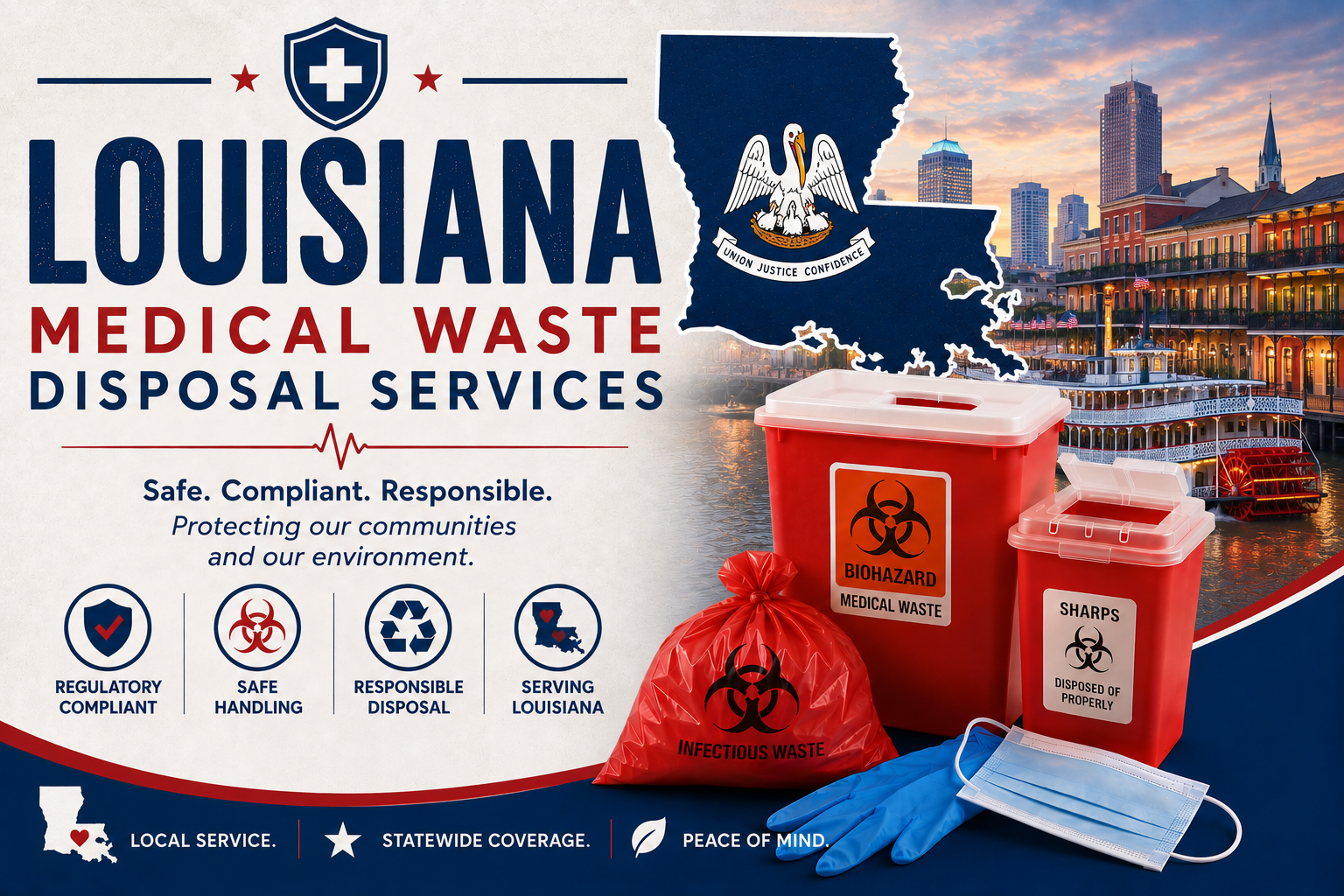
Louisiana Medical Waste Disposal, Made Simple and More Affordable
Across the Pelican State, healthcare facilities are cutting compliance costs and eliminating disposal headaches. Here is how proper Louisiana medical waste disposal keeps your practice LDEQ and LDH-compliant while saving thousands every year.
Louisiana medical waste disposal is more than a routine pickup. Instead, it is a legal obligation that protects your staff, your patients, and the communities from the Mississippi Delta to the Gulf Coast. From a busy New Orleans hospital to a small-town dental office in Lafayette, moreover, every generator of regulated waste in Louisiana must follow specific handling, storage, and transport rules. Consequently, choosing the right disposal partner is one of the smartest financial and compliance decisions a Louisiana facility can make. Above all, Amergy Disposal helps hundreds of businesses stay compliant while trimming costs that legacy haulers quietly inflate year after year.
In this guide, therefore, we break down exactly what Louisiana requires, how much you could save, and where Amergy is already helping facilities across the Pelican State. Additionally, we include the local agency phone numbers, the state-specific requirements, and a few fun facts you probably did not know about waste in Louisiana.
The Bottom LineHow Louisiana Businesses Are Saving Thousands
Medical waste contracts are notorious for hidden fees. Specifically, legacy vendors bury automatic price increases, fuel surcharges, environmental fees, and long-term auto-renewal clauses inside the fine print. As a result, a facility that signed at a fair rate five years ago may now be overpaying by 30% to 50% without ever agreeing to it. Meanwhile, the invoices keep climbing.
Amergy, in contrast, takes the opposite approach. Notably, we offer transparent, flat-rate pricing with no surprise surcharges and no punishing multi-year lock-ins. Therefore, Louisiana facilities that switch typically see immediate, measurable savings. In fact, many practices recover thousands of dollars annually simply by right-sizing pickup frequency and eliminating the “phantom fees” their old hauler was charging.
10 Louisiana Businesses That Generate the Most Medical Waste
Not every facility produces the same volume of regulated waste. Notably, the ten business types below generate the highest volumes across Louisiana; as a result, they have the most to gain from smarter Louisiana medical waste disposal. Meanwhile, the estimated monthly savings reflect typical reductions when switching from a legacy national hauler to Amergy.
| Business Type | Why Volume Is High | Est. Monthly Savings |
|---|---|---|
| Hospitals & Health Systems | 24/7 surgical, ER, and inpatient waste streams | $800 – $2,400 |
| Surgical & Ambulatory Centers | High sharps and single-use instrument volume | $450 – $1,300 |
| Dialysis Clinics | Bloodlines, filters, and daily treatment waste | $400 – $1,100 |
| Petrochemical & Offshore Health Clinics | Louisiana-specific energy-industry occupational care | $300 – $1,000 |
| Dental Practices | Extracted teeth, sharps, and infectious materials | $150 – $600 |
| Long-Term Care & Nursing Homes | Continuous resident care and sharps | $300 – $900 |
| Physician & Urgent Care Clinics | High patient throughput, vaccines, sharps | $200 – $700 |
| Medical & Clinical Laboratories | Cultures, stocks, and pathological waste | $350 – $1,000 |
| Veterinary Clinics | Animal-care infectious and sharps waste | $180 – $650 |
| Tattoo & Body Art Facilities | Licensed PIBW generators under LDH rules | $75 – $300 |
Estimates are illustrative and vary by facility size, pickup frequency, and current contract terms. Request a free quote for figures specific to your operation.
The RulesLouisiana Medical Waste Laws & Regulations
Louisiana medical waste disposal is governed jointly by two state agencies. Specifically, the Louisiana Department of Environmental Quality (LDEQ) handles solid and hazardous waste permits, transport, and enforcement, while the Louisiana Department of Health (LDH) regulates how the waste is handled, packaged, and treated. Furthermore, facilities must also comply with federal OSHA Bloodborne Pathogens and U.S. DOT transport standards. Consequently, understanding how these layers fit together is essential to staying compliant.
Louisiana’s Own Term: “Potentially Infectious Biomedical Waste”
Rather than “regulated medical waste,” Louisiana uses the term “Potentially Infectious Biomedical Waste,” or PIBW. Notably, every untreated container must be labeled with that exact phrase. Moreover, PIBW covers sharps, pathological waste, cultures and stocks, blood and blood products, and any refuse that has contacted those materials.
Key Louisiana Regulatory References
- LAC Title 33, Part VII, §711.D.1.e — the LDEQ Solid Waste Regulations addressing medical waste.
- Louisiana Sanitary Code, Chapter XXVII — the LDH rules for handling, packaging, storage, and treatment.
- LAC Title 33, Part III, Chapter 25 — performance standards for biomedical waste incinerators.
- OSHA 29 CFR 1910.1030 — the federal Bloodborne Pathogens Standard for worker safety.
Medical Waste Requirements Unique to Louisiana
While much of medical waste regulation is federal, Louisiana layers on several state-specific requirements that facilities must know. Consequently, a compliance program built for another state will not automatically satisfy LDEQ and LDH.
Segregate at the Point of Origin
First, Louisiana requires that PIBW be separated from ordinary trash at the point of origin. Moreover, liquids must go in sturdy, leak-resistant containers, while sharps must go in closed, rigid, break-resistant, puncture-resistant containers. As a result, segregation begins at the bedside, not the loading dock.
Permitted Transporters Only
Next, it is illegal to transport medical waste in Louisiana without a permit from the State Health Officer. In addition, the hauler must maintain a Medical Waste Transporter Registration with LDEQ. Therefore, verifying your transporter’s credentials is itself a compliance step.
No Compactors, and a 30-Day Storage Limit
Furthermore, Louisiana prohibits the use of compactors for storing PIBW. Meanwhile, unrefrigerated waste generally may not be stored longer than 30 days from the date of generation. Consequently, pickup frequency has to be planned, not improvised.
Supplemental Labels After Treatment
Finally, once waste is treated but still recognizable, Louisiana requires a supplemental label. Specifically, that label must state the treatment method, the date, and the name or initials of the person responsible. As a result, the paper trail follows the waste from generation all the way through treatment.
Your PartnerHow Amergy Helps Louisiana Businesses Stay Compliant
Staying compliant with Louisiana medical waste disposal rules does not have to be complicated or expensive. In fact, Amergy is built to remove the burden entirely. Accordingly, here is how we protect Louisiana facilities:
- LDEQ and LDH alignment — service that satisfies both agencies plus the Office of Public Health at once.
- PIBW-labeled containers — properly marked, leak-resistant, and puncture-proof supplies delivered to your door.
- Permitted transport — hauling backed by State Health Officer permits and LDEQ transporter registration.
- Cradle-to-grave documentation — complete manifests and supplemental treatment labeling.
- Right-sized scheduling — pickup frequency that keeps you inside the 30-day storage limit.
- Transparent pricing — flat rates with no surprise fuel or environmental surcharges.
Every Amergy Customer Gets Our Online Safety & Compliance Portal
Compliance is not just about pickups. Rather, it is about proof. Accordingly, every Amergy customer receives free access to our online Safety & Compliance Portal, a secure hub for OSHA training, digital manifests, disposal records, and required documentation. As a result, when an LDEQ or LDH inspector asks, your entire compliance history is a click away. Moreover, the portal keeps your team trained, your records organized, and your facility inspection-ready year-round.
20 Louisiana Cities Where Amergy Keeps Customers Compliant
Amergy provides Louisiana medical waste disposal across the Pelican State — from the bayous to the Red River. Below, therefore, are the 20 most populous Louisiana communities where we help healthcare facilities stay compliant and save money.
Do not see your town listed? Regardless, Amergy serves communities of every size across Louisiana. Contact us for a free quote and we will confirm coverage for your location.
Local ResourcesLouisiana Regulatory & Business Contacts
Keep these Louisiana agency contacts handy for questions about permits, waste classification, and compliance. Of course, for hands-on disposal help, Amergy is always just a phone call away.
Louisiana Fun Facts: Waste, Health & the Pelican State
The Pelican State Standard
Named for the brown pelican on its flag, Louisiana pairs its love of the coast with strict rules to keep biomedical waste out of its bayous and wetlands.
It Has Its Own Name
Unlike most states, Louisiana calls the material “Potentially Infectious Biomedical Waste” — and that exact phrase must appear on every untreated container.
Energy-Industry Clinics
Uniquely, Louisiana’s petrochemical plants and offshore energy operations run occupational health clinics that add a specialized regulated-waste stream.
Sharps Dominate the Stream
In Louisiana, sharps account for roughly 80% of the medical waste generated by healthcare facilities — a striking share of the total.
No Compactors Allowed
Louisiana specifically prohibits using compactors to store biomedical waste, keeping the material intact and traceable until treatment.
Even Body Art Counts
From Mardi Gras to Bourbon Street, Louisiana’s licensed tattoo and body art facilities are explicitly regulated as PIBW generators.
Simplify Louisiana Medical Waste Disposal With Amergy
Compliance You Can Prove
From the LDEQ and LDH dual framework to OSHA’s labeling standards, Louisiana medical waste disposal comes with real obligations. Fortunately, however, Amergy handles them for you — with PIBW-labeled containers, permitted transport, and a Safety & Compliance Portal that keeps you audit-ready.
Savings You Can Measure
Legacy haulers thrive on hidden fees and locked-in contracts. Amergy, by contrast, does the opposite. As a result, Louisiana facilities routinely save thousands of dollars a year after switching — without sacrificing reliability.
Service You Can Trust
From New Orleans to Shreveport, Amergy is already helping Louisiana businesses stay compliant and spend less. Ultimately, waste should be one less thing you worry about. Therefore, let us make it simple.