
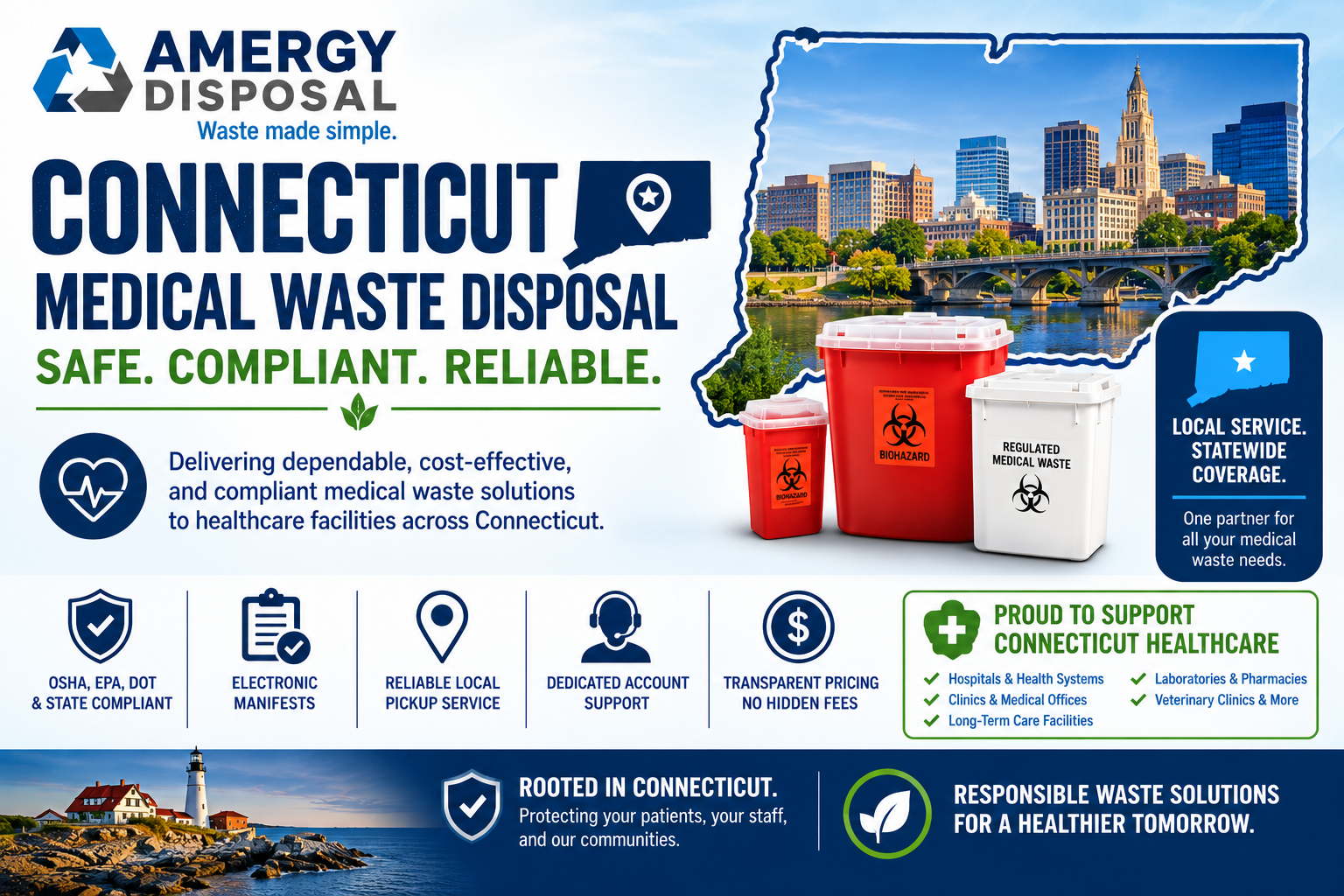
Connecticut Medical Waste Regulations: What Every Healthcare Facility Needs to Know
A practical guide to Connecticut DEEP biomedical waste requirements, generator obligations, tracking forms, and how to stay fully compliant.
Regulating Agency
CT DEEP
State Statute
22a-209 CGS
Regulation Section
22a RCSA 209-15
Tracking Form
Required
Licensed Transporter
Required
Mgmt Plan (BWMP)
Required
Who Regulates Medical Waste in Connecticut?
In Connecticut, medical waste is officially called biomedical waste (BMW). The primary regulatory authority is the Connecticut Department of Energy and Environmental Protection (DEEP), which enforces rules under Section 22a-209 of the Connecticut General Statutes and the detailed Regulations of Connecticut State Agencies at 22a RCSA 209-15.
DEEP defines biomedical waste as infectious, pathological, and/or chemotherapy waste generated during the administration of medical care or the performance of medical research involving humans or animals. This definition is broader than what many other states apply, meaning more waste streams fall under mandatory compliance in Connecticut than generators may expect.
Connecticut also operates in parallel with OSHA’s Bloodborne Pathogen Standard (29 CFR 1910.1030) and relevant federal transportation rules under 49 CFR Subchapter C. When a facility handles biomedical waste that also carries characteristics of hazardous waste, Connecticut’s hazardous waste management regulations under RCRA apply as well.
What is Regulated as Biomedical Waste in Connecticut?
Connecticut’s regulatory definition captures the following waste categories as biomedical waste requiring compliant management and disposal:
- Infectious waste — materials likely to contain pathogens in sufficient concentration to cause disease in a healthy human, including cultures, patient isolation waste, and contaminated items from patients with communicable diseases
- Pathological waste — human anatomical waste including tissues, organs, body parts, and fluids removed during surgery, autopsy, or biopsy
- Sharps waste — needles, syringes, scalpels, lancets, and other devices capable of puncturing skin, whether contaminated or not
- Chemotherapy waste — materials contaminated with antineoplastic agents or cytotoxic drugs used in cancer treatment
- Microbiological waste — laboratory cultures, specimens, live or attenuated vaccines, and research materials containing infectious agents
- Blood and blood products — liquid blood, serum, plasma, and materials saturated with blood from any human source
- Animal waste — carcasses, body parts, and bedding of animals exposed to infectious agents during research or veterinary care
Biomedical waste becomes regulated as hazardous waste only when it also exhibits characteristics of hazardous waste as defined by Connecticut’s hazardous waste regulations. In those cases, more stringent RCRA-aligned requirements apply on top of the biomedical waste rules.
Connecticut Biomedical Waste Generator Requirements
Connecticut’s regulations under 22a RCSA 209-15 are organized into distinct sections that cover each stage of the waste management process. Every generator in Connecticut must understand and comply with all applicable sections.
209-15(b) Generator Requirements
All generators must develop and maintain a written Biomedical Waste Management Plan (BWMP) that documents internal policies and procedures for handling, packaging, labeling, storing, and disposing of all biomedical waste streams produced at the facility.
209-15(c) Storage Requirements
Biomedical waste must be stored in a manner that protects it from the elements, prevents animal access, and keeps waste in a non-putrescent state. Storage areas must be constructed of impermeable materials and display a biohazard symbol. Refrigeration is permitted but not always required.
209-15(d) Transfer Requirements
Before moving biomedical waste off-site, generators must ensure all packaging and labeling is compliant, a licensed transporter has been engaged, and tracking documentation has been prepared. Untreated waste cannot leave the facility without a properly completed tracking form.
209-15(e) Transportation Requirements
Off-site transport of biomedical waste requires a DEEP-permitted transporter. Self-transport by a generator is generally not allowed for commercial quantities. All vehicles carrying biomedical waste must meet applicable DOT labeling and placarding requirements.
209-15(f) Treatment and Disposal
Biomedical waste must be rendered non-infectious prior to final disposal. Approved treatment methods include autoclaving, incineration, and other DEEP-approved technologies. Treated waste must meet DEEP performance standards before it can be disposed of as general solid waste.
209-15(h) & (i) Tracking and Recordkeeping
Connecticut requires use of the state’s Biomedical Waste Tracking Form for all off-site shipments. Generators must assign a unique tracking form number to each shipment, retain their copy of completed forms, and maintain all records in accordance with DEEP’s retention requirements.
The Connecticut Biomedical Waste Tracking Form
One of the most distinctive elements of Connecticut’s compliance framework is its state-specific Biomedical Waste Tracking Form. This is not the standard federal hazardous waste manifest — it is a separate Connecticut document required for all off-site shipments of biomedical waste.
The tracking form must be completed before any untreated biomedical waste leaves the generator’s site. Key fields include:
- Generator name, address, and state permit or ID number
- Unique tracking form number — assigned by the generator for each individual shipment
- Transporter name, address, and DEEP permit number
- Waste description — distinguishing untreated from decontaminated biomedical waste
- Transporter signature and date of acceptance
- Destination facility information and certification of receipt
The tracking form travels with the waste and generates multiple copies. The generator retains one copy at pickup and receives a second copy back from the destination facility confirming receipt and treatment. If a generator does not receive confirmation from the destination facility within the required timeframe, additional recordkeeping and follow-up obligations are triggered.
Transporter Licensing in Connecticut
Connecticut requires all companies engaged in the business of transporting biomedical waste to hold an active DEEP permit. This requirement applies to any transporter moving biomedical waste in or through Connecticut, not just companies based in the state.
DEEP maintains a publicly accessible list of licensed biomedical waste transporters. Using an unlicensed transporter — even unknowingly — places full compliance liability on the generator. It is the generator’s responsibility to verify a transporter’s permit status before any waste is picked up.
Additionally, anyone transporting hazardous waste in Connecticut must have a separate DEEP permit under Section 22a-454 of the Connecticut General Statutes, unless the generator is self-transporting 1,000 kilograms or less of their own waste to a permitted facility. For biomedical waste that carries hazardous characteristics, both permit requirements may apply simultaneously.
Storage Requirements at a Glance
Proper on-site storage is a frequent area of inspection focus for DEEP. Connecticut’s requirements are specific and non-negotiable:
| Requirement | Connecticut Standard | Status |
|---|---|---|
| Biohazard signage in storage area | Universal biohazard symbol and/or “BIOHAZARD” text posted | Required |
| Impermeable storage surfaces | Finished, non-porous walls and floors in storage areas | Required |
| Protection from elements and animals | Waste must be kept contained, secured, and inaccessible to wildlife | Required |
| Non-putrescent state | Waste must not be allowed to decompose; refrigeration is permitted | Required |
| Refrigeration | Optional but permitted for extended storage | Permitted |
| Approved containers | Rigid, leak-proof, puncture-resistant containers per DEEP standards | Required |
| Proper labeling on containers | Biohazard symbol, waste type, and generator information | Required |
Most Common Connecticut Compliance Violations
Connecticut DEEP enforcement actions consistently identify the same categories of violations. Here is what to watch for at your facility:
- No written Biomedical Waste Management Plan (BWMP). Connecticut requires all generators to maintain a written BWMP on site. Facilities that have not formalized their procedures into a written plan are in violation even if their practices are correct.
- Incomplete or missing tracking forms. The state tracking form must accompany every off-site shipment. Missing fields, incorrect transporter information, or failure to retain generator copies are the most frequently cited documentation issues.
- Using an unlicensed transporter. DEEP maintains an active list of permitted biomedical waste transporters. Engaging a company that is not on that list exposes the generator to direct liability.
- Non-compliant storage areas. Storage spaces that lack proper biohazard signage, use porous surfaces, or fail to prevent animal access are a common inspection finding.
- Improper container labeling. Containers missing the biohazard symbol, waste type designation, or generator contact information do not meet DEEP standards and can result in refusal by the transporter or a citation at inspection.
- Failure to follow up on missing manifests. If a generator does not receive confirmation of receipt from the destination facility, Connecticut requires specific follow-up steps and additional recordkeeping. Many facilities are unaware of this obligation.
- Mixing waste streams. Placing chemotherapy waste, sharps, or pharmaceutical waste into standard red bag streams creates cross-contamination that violates both DEEP and OSHA requirements.
Connecticut Pharmaceutical Waste: An Additional Layer
Connecticut generators that handle pharmaceutical waste face requirements beyond the biomedical waste rules. DEEP has been actively updating pharmaceutical waste management guidance in alignment with the federal Resource Conservation and Recovery Act (RCRA) Subpart P pharmaceutical waste rule.
Hazardous pharmaceutical waste — including many common medications — must be managed under Connecticut’s hazardous waste program, not the biomedical waste framework. This distinction matters because the two programs use different tracking forms, require different transporters, and route waste to different disposal facilities.
Non-hazardous pharmaceutical waste that does not meet RCRA characteristics still requires careful handling to prevent disposal through standard drain or trash channels. Connecticut facilities should work with a compliance partner to clearly identify which pharmaceutical waste streams fall under which regulatory program.
How Amergy Disposal Serves Connecticut Facilities
Amergy Disposal provides full-service regulated medical waste management throughout Connecticut, from solo practices in rural communities to multi-site hospital systems serving the Hartford and New Haven corridors.
Our Connecticut compliance program is built around four core capabilities:
DEEP-Permitted Transportation
Amergy holds all required DEEP permits for biomedical waste transportation in Connecticut. Your tracking forms are always clean and your chain of custody is always intact.
State-Compliant Containers
We supply properly labeled, DEEP-compliant containers for all biomedical waste streams including sharps, red bag, chemotherapy, and pharmaceutical waste.
Tracking Form Management
Our team handles Connecticut’s Biomedical Waste Tracking Form documentation from pickup through destination confirmation, keeping your records audit-ready at all times.
BWMP Development Support
We help facilities create and maintain their written Biomedical Waste Management Plans, one of the most commonly cited missing documents during DEEP inspections.
Whether your Connecticut facility generates a handful of sharps containers per month or manages complex multi-stream biomedical and pharmaceutical waste, Amergy Disposal provides the documentation, logistics, and expertise to keep you fully protected.
Is Your Connecticut Facility Fully Compliant?
Get a free compliance review from Amergy Disposal. We will assess your biomedical waste program against Connecticut DEEP requirements at no cost — and flag any gaps before they become citations.
Request Your Free CT Compliance Review →