
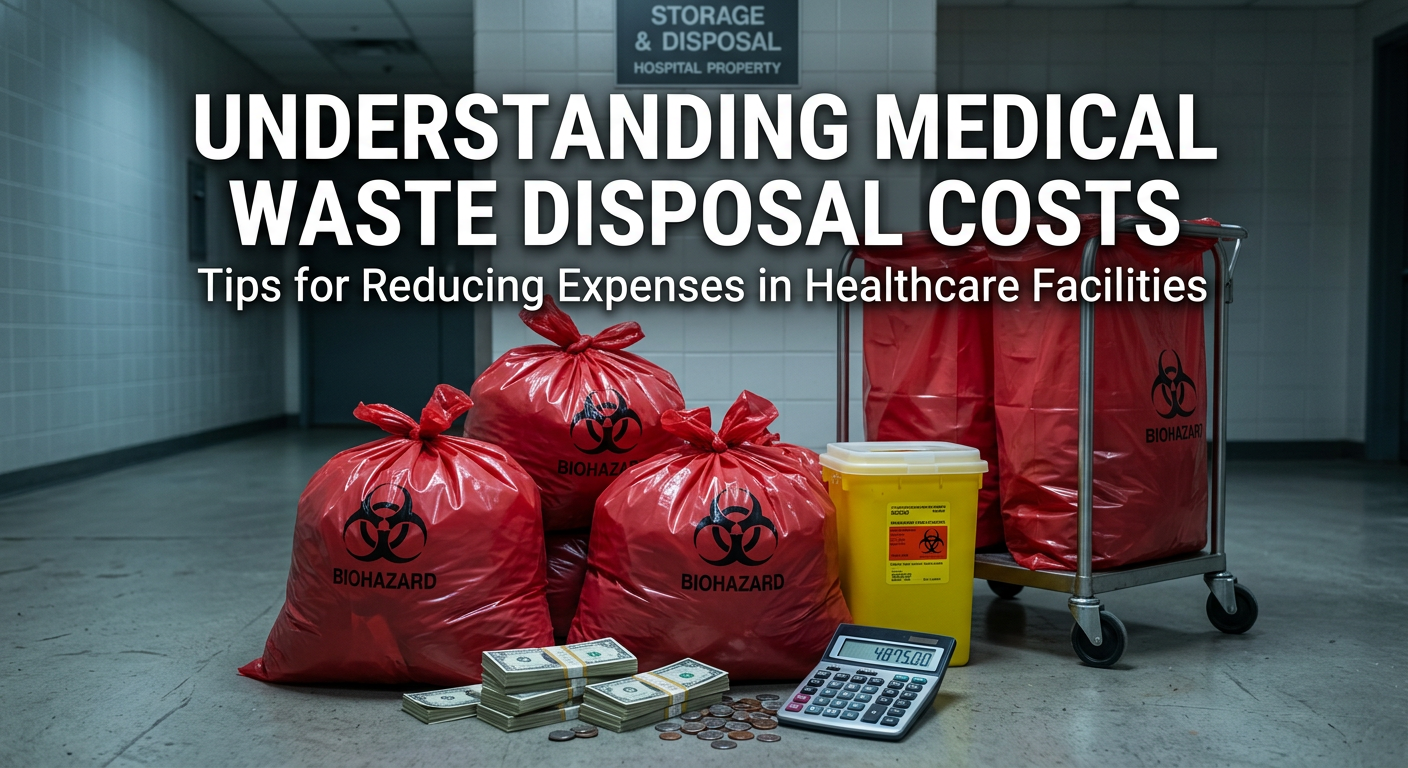
How Much Does Medical Waste Disposal Really Cost? What Healthcare Facilities Need to Know in 2026
Hidden fees. Locked-in contracts. Pricing that changes without warning. We’re pulling back the curtain on what regulated medical waste disposal actually costs — and what your facility should demand from any provider before signing anything.
If you’ve ever received a medical waste disposal invoice that didn’t match the quote you were given, you’re not alone. The industry has long relied on variable pricing, fuel surcharges, container fees, and multi-year contracts that lock in clients before the real costs become clear. In 2026, healthcare facilities of every size are pushing back — and demanding transparency.
This post breaks down exactly what regulated medical waste disposal costs, where hidden fees tend to hide, what real savings look like, and the questions you should ask any provider before committing. We’ll also share data from our own clients — because if a provider can’t show you proof of savings, they probably can’t deliver them.
1. What actually drives medical waste disposal costs
Medical waste disposal isn’t a single-price commodity. Your cost depends on several variables, and understanding them puts you in a much stronger negotiating position.
Waste type
Not all waste streams are priced equally. Regulated medical waste (biohazard bags, sharps) is the most common and carries base pricing. Pharmaceutical waste — especially controlled substances and trace chemotherapy — requires specialized handling and is priced at a premium. Pathological waste (tissues, organs) often carries the highest per-unit cost due to strict incineration requirements.
Volume and frequency
Higher volume generators almost always pay less per pound. A hospital generating hundreds of pounds per week will negotiate rates dramatically lower than a solo physician’s office with a single 18-gallon container. If your volume is predictable, use that as leverage — fixed-volume pricing locks in your rate regardless of slight weekly variation.
Location and logistics
Proximity to treatment facilities, route density, and state-specific regulations all factor in. Rural providers often pay a geographic premium. Providers with dense local route networks — meaning they service many facilities in your area — can offer better economics because their per-stop cost is lower.
Contract length and structure
This is where most facilities get burned. Long-term contracts (three to five years) often come with low introductory pricing and aggressive escalation clauses. A price that looks competitive in year one may be well above market by year three — and you’ll have no leverage to renegotiate until the contract expires.
“We were paying what seemed like a fair rate — until we actually compared it. Three years into our contract, we were 40% above market and couldn’t do anything about it.”
2. 2026 pricing breakdown by facility type
Here is what healthcare facilities across the country are paying for regulated medical waste disposal in 2026, based on current market data and Amergy client intake information.
| Facility Type | Typical Monthly Volume | Market Range (monthly) | Amergy Fixed Price |
|---|---|---|---|
| Solo physician / small clinic | 15–30 lbs | $75 – $200 | From $69 |
| Multi-physician group practice | 30–80 lbs | $150 – $380 | From $140 |
| Dental practice | 10–25 lbs | $65 – $175 | From $59 |
| Veterinary clinic | 20–50 lbs | $90 – $240 | From $85 |
| Urgent care center | 50–150 lbs | $200 – $550 | From $185 |
| Long-term care / nursing home | 80–200 lbs | $280 – $700 | From $260 |
| Surgery center / ASC | 100–300 lbs | $350 – $950 | From $320 |
Note: Amergy prices are all-inclusive — container rental, pickup, treatment, disposal, and documentation. No fuel surcharges, no extra billing for manifest copies, no container swap fees.
3. The hidden fees most providers don’t advertise upfront
When comparing bids, the base service quote is only the starting point. Here are the line items that routinely inflate actual invoices — and that you should ask about explicitly before you sign.
- ✓Fuel surcharges: Many national providers add a percentage-based fuel surcharge that fluctuates monthly. On a $400 service, a 12% surcharge is nearly $50 per month in unpredictable cost.
- ✓Container rental or swap fees: Some providers bill separately for the containers they leave on-site, and charge again when they swap them. Ask whether containers are included.
- ✓Manifest and documentation fees: Federal and state regulations require documentation for every regulated waste pickup. Some providers charge $5–$20 per manifest copy — a cost that adds up over dozens of pickups a year.
- ✓Minimum service charges: If your volume drops below a threshold in a given month, you may be billed for the minimum regardless of what was actually picked up.
- ✓Early termination fees: Multi-year contracts often include penalties of several months of service fees if you need to exit early. These can run into thousands of dollars.
- ✓Annual price escalation clauses: Look for language allowing the provider to raise rates 3–7% annually without your approval. Over a five-year contract, that’s a compounding cost increase you agreed to in the fine print.
- ✓Compliance training add-ons: OSHA and HIPAA training is often sold as a premium upsell. Amergy includes OSHA compliance training as part of the service package — not as an optional extra.
4. Real client results: before and after switching to Amergy
We were with a national provider for four years and assumed we were getting a fair deal. Amergy audited our invoices and found $340 a month in fees we didn’t even know we were paying — fuel surcharges, manifest fees, and a container swap charge that was burying us. We switched, our service improved, and we’re saving over $4,000 a year.
Our long-term care facility generates a predictable volume every month. What we needed was a price that didn’t change, a driver who showed up on schedule, and someone we could actually call when we had a question. Amergy gave us all three — and our monthly cost went down by nearly 30%.
Pharmaceutical waste was our pain point — our previous provider kept reclassifying items and billing us at higher rates with no explanation. Amergy gave us a clear breakdown of what each waste stream costs and hasn’t deviated from it once in 14 months. That predictability is worth as much as the savings.
Multi-Location Urgent Care Group — Southwest US
A regional urgent care group operating six locations in the Southwest had been with the same national provider for seven years. A routine contract renewal revealed pricing that had escalated 28% over that period via annual clauses they had not actively monitored. Amergy conducted a no-obligation waste audit, identified redundant container sizes at three locations, right-sized the service plan, and launched service across all six sites within two weeks of signing. The group now pays a single fixed monthly rate per location with no variable fees — and receives quarterly compliance reports for each site at no additional charge.
5. What non-compliance actually costs you in 2026
Choosing the cheapest provider without verifying their compliance track record is a false economy. The financial exposure from regulatory violations far outweighs any monthly savings on the service contract.
OSHA violations classified as “serious” can now exceed $15,000 per violation. EPA fines for improper pharmaceutical disposal can reach $70,000 or more per day. Repeated violations can result in revocation of your operating license. A single enforcement action can cost more than a decade of compliant waste disposal service.
It’s also worth noting that major providers are not immune to compliance failures. In January 2025, a national provider paid a $9.5 million settlement to the EPA — one of the largest civil penalties ever assessed under the Resource Conservation and Recovery Act — for improper hazardous waste management and manifesting failures. The facilities they served were not directly fined, but the disruption to service and documentation created real compliance headaches for their customers.
When evaluating any provider, ask for their compliance history, their manifest error rate, and how they handle documentation if a pickup is missed or delayed. A provider that can’t answer those questions clearly is a liability, not just a vendor.
6. What to ask any medical waste provider before you sign
Before committing to any regulated medical waste disposal provider — including Amergy — ask these questions and get the answers in writing.
- ✓Is this price all-inclusive? Ask them to list every possible fee — fuel, containers, manifests, compliance documents — and confirm whether they’re included or billed separately.
- ✓What is the contract length and termination process? Month-to-month or short-term agreements give you flexibility. Multi-year contracts with auto-renewal clauses do not.
- ✓Does pricing escalate automatically? Ask for the exact escalation clause language. A 5% annual increase compounding over five years adds up to more than 27%.
- ✓Who is my dedicated contact? National providers often route all calls through a general call center. Ask whether you’ll have an assigned account representative with a direct line.
- ✓Do you provide compliance training? OSHA Bloodborne Pathogen training, HIPAA, and DOT training should be included or available — not sold separately as a premium package.
- ✓What is your compliance track record? Ask for their EPA and OSHA violation history. A provider with recent regulatory penalties is a risk to your facility’s own compliance standing.
- ✓Can you show me a sample invoice? The easiest way to spot hidden fees is to look at a real invoice from a similar-sized client — not just the quote sheet.
7. Frequently asked questions
How much does medical waste disposal cost per pound in 2026?
The average cost ranges from $0.30 to $0.80 per pound for regulated medical waste (before transportation costs). Smaller generators pay toward the higher end; high-volume facilities negotiate lower per-pound rates. Pharmaceutical and pathological waste streams carry a premium above these base rates. Amergy provides fixed all-inclusive pricing — contact us for a quote specific to your facility’s waste profile.
Can I get medical waste disposal without a long-term contract?
Yes. Amergy offers flexible contract terms with no multi-year lock-in. You receive the same service guarantee, fixed pricing, compliance documentation, and dedicated account representative regardless of your contract length.
What’s included in a complete medical waste disposal service?
A complete service should include: on-site containers and swap-outs, scheduled pickup, proper manifesting and chain-of-custody documentation, transport, treatment, disposal, and compliance support. If any of these are billed as add-ons rather than included, that provider’s base quote is not comparable to an all-in price.
Does Amergy service my area?
Amergy Disposal serves all 48 continental United States through a network of licensed transfer and treatment facilities. Contact us at (646) 926-7724 to confirm coverage in your specific location.
How quickly can service start?
In most markets, Amergy can have containers delivered and first pickup scheduled within five to ten business days of signing. For multi-location or urgent situations, contact us directly to discuss accelerated setup.
See what your facility should actually be paying
Get a free, no-obligation quote. We’ll review your current service and give you a transparent, fixed-price alternative — no hidden fees, no long-term lock-in.
Get My Free Quote →Or call us: (646) 926-7724 · Mon–Fri 8am–5pm