
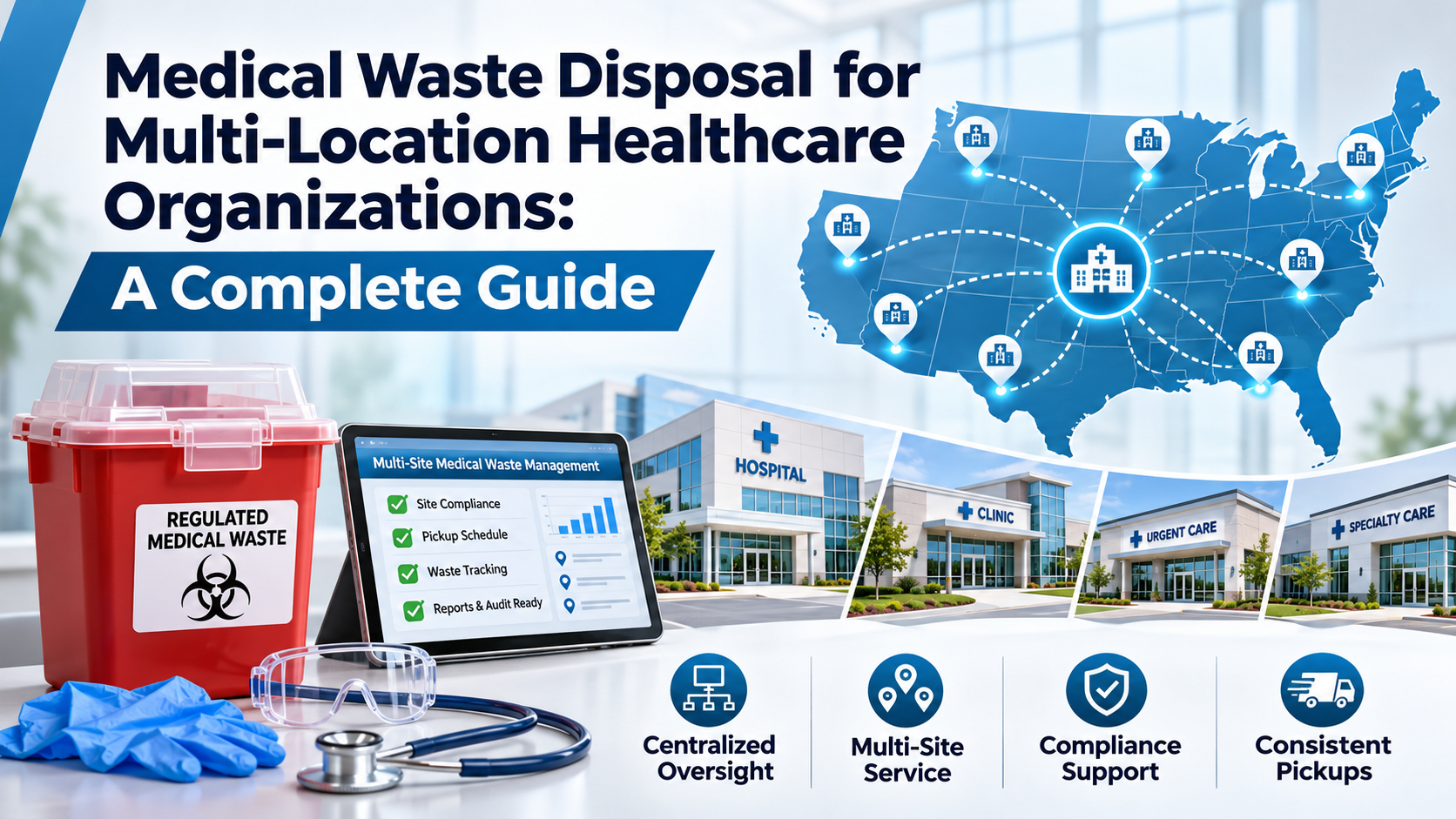
Medical Waste Disposal for Multi-Location Healthcare Organizations: A Complete Guide
How to run one compliant, cost-controlled program across every clinic, office, and facility you operate.
Multi-location medical waste disposal is the process of managing regulated medical waste across two or more healthcare sites under one program. That includes how waste is sorted, stored, picked up, treated, documented, and billed at each location.
If you run a dental group, a physician network, an urgent care chain, or a regional health system, you already know the problem. Every site does things a little differently. One office uses a local hauler. Another signed a contract years ago that nobody can find. A third just opened in a new state with rules you haven’t read yet.
This guide shows you how to fix that. You’ll learn which rules apply, which waste streams to plan for, and how to build a program that works the same way at site one and site fifty.
What Is Multi-Location Medical Waste Disposal?
At a single clinic, medical waste is mostly a scheduling task. You fill the containers, the truck comes, and you file the paperwork. With many sites, it becomes a management system.
A strong multi-location medical waste disposal program has four parts:
- Standard procedures that every site follows for sorting, labeling, and storage.
- Consistent service from a vendor who can cover your whole footprint.
- Central records so you can pull any manifest or training log in minutes.
- Clear reporting on volume, cost, and compliance by location.
In other words, the goal is simple. Every location should be safe, compliant, and easy to audit. And you should be able to see all of it from one place.
Why Managing Medical Waste Across Many Sites Gets Hard
Most organizations don’t plan their waste program. Instead, it grows one location at a time. As a result, the gaps show up later, usually during an inspection or a budget review.
Rules change at the state line
Storage time limits, labeling, treatment methods, and generator registration all vary by state. A practice that is fully compliant in New Jersey can be out of compliance in Texas with the exact same setup.
Too many vendors and contracts
Acquired practices often bring their own haulers. Over time, you can end up with five vendors, five rate sheets, and five sets of fuel surcharges. Because of this, it’s hard to know what you actually pay.
Inconsistent training
Staff turnover is constant in healthcare. If training depends on each office manager, some sites will fall behind. That leads to mixed waste streams, overfilled sharps containers, and higher costs.
Scattered paperwork
Manifests, certificates of destruction, and training records often live in filing cabinets at each site. So when an auditor or inspector asks for them, you lose days tracking them down.
The Regulations That Apply to Every Location
Here’s the most important thing to understand. There is no single federal medical waste law today. The EPA has not had direct authority over medical waste since the Medical Waste Tracking Act expired in 1991. Since then, states have regulated it through their environmental and health departments.
However, several federal rules still apply at every site. Think of compliance as two layers: a federal floor that never changes, and a state layer that changes with each address.
OSHA Bloodborne Pathogens Standard (29 CFR 1910.1030)
This rule protects workers who may be exposed to blood or other potentially infectious materials. Each location needs a written exposure control plan, proper sharps containers, PPE, and staff training at hire and every year after. Employers who keep OSHA injury records must also keep a sharps injury log. Learn more in our guide to OSHA bloodborne pathogen requirements.
DOT Hazardous Materials Regulations (49 CFR)
DOT treats regulated medical waste as a hazardous material once it leaves your building. That means approved packaging, correct labels, and proper shipping papers. Staff who package waste for transport need DOT hazmat training at least every three years.
EPA rules for hazardous waste pharmaceuticals (40 CFR 266, Subpart P)
Some pharmaceuticals count as hazardous waste under federal law. EPA’s Subpart P rule sets handling standards for healthcare facilities. It also bans all healthcare facilities from flushing or “sewering” hazardous waste pharmaceuticals. That ban took effect nationwide in August 2019.
DEA rules for controlled substances (21 CFR Part 1317)
Unused controlled substances must be destroyed in a way that makes them non-retrievable. Each location that stocks controlled drugs needs a clear process and records for this.
State medical waste rules
This is where multi-site programs get tricky. Depending on the state, you may need to register as a generator, keep a written waste plan, follow storage time limits, or use specific treatment methods. For state-by-state details, see our medical waste regulations by state resource.
Waste Streams Your Locations Likely Generate
Different sites produce different waste. A surgery center generates far more than a primary care office. Still, most healthcare organizations manage the same core streams. The container colors below are common industry practice. Always confirm your state’s labeling rules.
| Waste stream | Common examples | Typical container |
|---|---|---|
| Regulated medical waste (biohazard) | Blood-soaked gauze, used PPE with visible blood, culture dishes | Red bag or red container |
| Sharps | Needles, syringes, scalpels, lancets, broken glass | Red puncture-resistant sharps container |
| Pathological waste | Tissue, organs, body parts | Red container marked for incineration |
| Trace chemotherapy waste | Empty IV bags, tubing, gowns used with chemo drugs | Yellow container |
| Hazardous pharmaceutical waste | Certain P-listed and U-listed drugs | Black container |
| Non-hazardous pharmaceutical waste | Most expired or unused medications | Blue and white container |
| Dental and specialty waste | Amalgam, lead foils, X-ray fixer | Specialty recycling containers |
Sorting matters for cost, too. When ordinary trash goes into red bags, you pay medical waste rates for it. That is one of the most common and fixable sources of overspending at multi-site organizations. For more detail, read our guide to pharmaceutical waste disposal and our breakdown of chemotherapy waste disposal.
Centralized vs. Site-by-Site Medical Waste Programs
Some organizations let each location manage its own waste. Others run everything from a central office. Here’s how the two models compare.
| Factor | Site-by-site | Centralized program |
|---|---|---|
| Vendors | Many, chosen locally | One partner for all sites |
| Pricing | Uneven, hard to compare | One rate structure with volume leverage |
| Procedures | Vary by office manager | One standard playbook |
| Training | Depends on each site | Scheduled and tracked centrally |
| Records | Stored at each location | One digital system, searchable |
| Audit readiness | Slow and uncertain | Fast and consistent |
| New locations | Start from scratch | Onboard with a proven template |
For most groups with three or more sites, a centralized model wins. It gives you control without asking every office manager to become a compliance expert.
How to Build a Multi-Location Medical Waste Disposal Program in 8 Steps
-
Audit every location
List each site, its state, the waste streams it produces, current vendor, pickup frequency, container sizes, and monthly cost. This baseline shows you where the waste and the money actually go.
-
Map the rules for each state
Note storage limits, registration needs, and labeling rules for every state you operate in. Then flag the strictest requirement in each category.
-
Write one standard procedure
Create a single waste handling guide that meets the strictest rules. Add a one-page addendum for state-specific items. Keep the language plain so front-line staff can follow it.
-
Consolidate vendors
Move to one partner that can serve all your locations. Make sure contracts cover every waste stream you produce, not just red bag and sharps.
-
Right-size service at each site
Match pickup frequency and container size to real volume. A busy surgery center may need weekly service. A small satellite office may only need a pickup every few months, or a mail-back sharps option where allowed.
-
Standardize training
Roll out the same bloodborne pathogen, waste segregation, and DOT training at every location. Track completion by employee and by site so nobody slips through.
-
Centralize documentation
Store manifests, certificates of treatment, training records, and exposure control plans in one place. Set a retention schedule that meets the longest requirement across your states.
-
Measure and review
Track pounds per location, cost per location, missed pickups, and training completion. Review every quarter. Outliers usually point to a sorting problem or an oversized service plan.
What to Look for in a Medical Waste Disposal Partner
Your vendor can make a multi-site program easy or painful. Use this checklist when you compare options.
- Coverage across your footprint. They can service every location you have today and the ones you plan to open.
- Full waste stream support. Biohazard, sharps, pathological, chemo, pharmaceutical, and hazardous waste under one agreement.
- One point of contact. A dedicated account manager who knows your whole organization.
- Clear, consolidated billing. One invoice or a clean roll-up, with no surprise fees.
- Built-in compliance support. Training, exposure control plan help, and audit-ready documentation.
- Digital records. Easy access to manifests and certificates for every site.
- Flexible scheduling. Service levels that can differ by site and adjust as volume changes.
- Fast onboarding. A simple process for adding new or acquired locations.
How to Lower Medical Waste Costs Across Locations
Medical waste is a recurring expense, so small gains add up fast across many sites. Start with these:
- Fix segregation first. Keep general trash out of red bags. Clear signs above each bin help a lot.
- Right-size pickups. Paying for weekly service at a low-volume site is money left on the table.
- Use your scale. Negotiate one rate for the whole network instead of site by site.
- Read the fine print. Watch for fuel surcharges, environmental fees, and auto-renewal price hikes.
- Prevent fines. OSHA penalties are adjusted for inflation every year, and serious violations can reach five figures each. Training and good records are cheaper than citations.
How Amergy Supports Multi-Location Healthcare Organizations
Amergy Disposal is a national regulated medical waste disposal and compliance company headquartered in Jefferson, New Jersey. We help healthcare groups replace a patchwork of vendors with one simple program.
That means one partner for medical, sharps, pharmaceutical, and hazardous waste. It also means a dedicated account team, consolidated billing, and service plans sized to each location. On top of that, our OSHA compliance training is led by instructors who hold the Certified Occupational Safety Specialist (C.O.S.S.) credential.
Whether you manage five dental offices or a regional network of clinics, we make multi-location medical waste disposal easy to run and easy to prove.
Frequently Asked Questions
Who regulates medical waste when my locations are in different states?
Each state regulates medical waste through its own environmental or health agency. The EPA has not had direct authority over medical waste since 1991. Federal rules from OSHA, DOT, EPA (for hazardous pharmaceuticals), and DEA still apply everywhere. So each location follows federal rules plus the rules of its state.
Is it cheaper to use one medical waste vendor for all locations?
Usually, yes. Consolidating gives you volume leverage, one rate structure, and fewer invoices to audit. It also removes hidden fees that pile up when each site signs its own contract. The bigger savings often come from right-sizing pickups and containers across the network.
How often do staff need medical waste training?
OSHA requires bloodborne pathogen training at hire and at least once a year for workers with occupational exposure. Staff who prepare regulated medical waste for transport also need DOT hazmat training at least every three years.
Can we flush expired or unused medications at our clinics?
Not hazardous waste pharmaceuticals. EPA’s Subpart P rule bans healthcare facilities nationwide from sewering them, and EPA discourages flushing any medication. Controlled substances must also be destroyed under DEA rules so they can’t be recovered.
What records should each location keep?
Keep manifests or shipping papers, certificates of treatment, training records, your exposure control plan, and a sharps injury log if you must keep OSHA injury records. Retention periods vary by state, so store everything centrally with one clear schedule.
How do we handle a location that only produces a small amount of waste?
Low-volume sites often do well with less frequent pickups or a mail-back sharps program, where state rules allow it. The key is matching service to real volume while still meeting your state’s storage time limits.
Ready to Simplify Waste Across Every Location?
Get one partner, one program, and one clear invoice. Talk to our team about a free review of your current multi-site setup.
Request a Free Program Review Waste made simple!Sources
U.S. EPA, Medical Waste (state authority since the Medical Waste Tracking Act expired in 1991); U.S. EPA, Management Standards for Hazardous Waste Pharmaceuticals, 40 CFR Part 266 Subpart P; OSHA Bloodborne Pathogens Standard, 29 CFR 1910.1030; DOT Hazardous Materials Regulations, 49 CFR Parts 171 to 180; DEA Disposal of Controlled Substances, 21 CFR Part 1317. This article is for general information and is not legal advice. Check your state’s current rules for each location.