
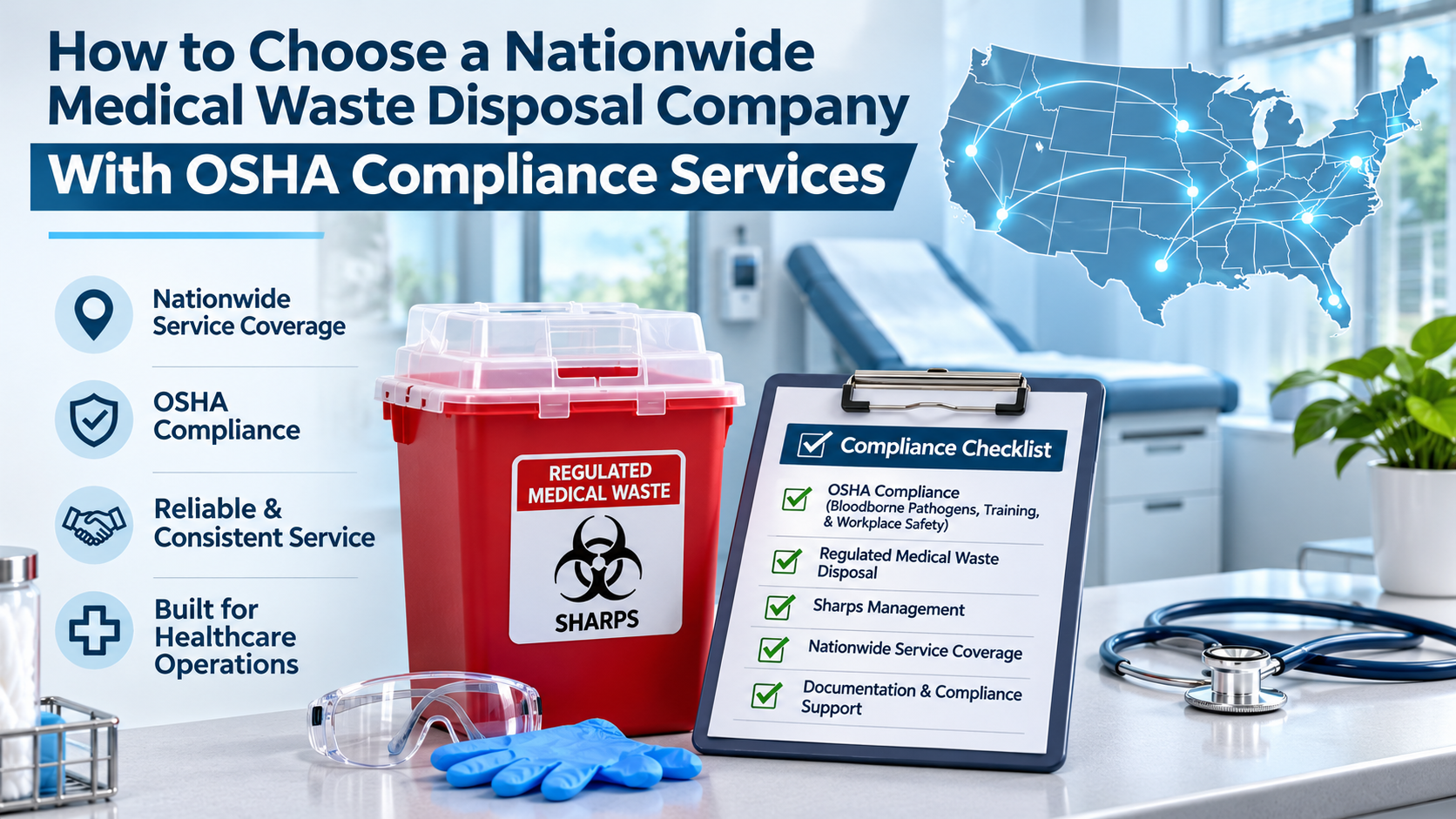
How to Choose a Nationwide Medical Waste Disposal Company With OSHA Compliance Services
Eight things to check before you sign. Plus what real OSHA support should look like when you have locations in more than one state.
The best nationwide medical waste disposal company covers every state you operate in, holds the right permits for each one, and gives you complete tracking records. It should also offer OSHA compliance services. That means bloodborne pathogens training, exposure control plan help, and audit-ready documentation. One vendor handling both waste and compliance cuts your risk and your paperwork.
If you run more than one healthcare location, you already know the problem. Every state has its own medical waste rules. Every site has its own staff to train. And OSHA does not care how many vendors you juggle. It only cares whether your people are protected and your records are complete.
That is why choosing a nationwide medical waste disposal company is a bigger decision than it looks. You are not just picking a hauler. You are picking a compliance partner. Here is how to get it right.
Why Does the Right Nationwide Medical Waste Disposal Company Matter?
Medical waste sits under several regulators at once. As a result, one weak link can expose your whole organization.
| Regulator | What it covers |
|---|---|
| State agencies | Most medical waste rules. Definitions, storage limits, treatment methods, and hauler permits vary by state. |
| OSHA | Worker safety under the Bloodborne Pathogens Standard (29 CFR 1910.1030). Training, sharps containers, labeling, and exposure plans. |
| DOT | Packaging, labeling, and transport of regulated medical waste as a hazardous material. |
| EPA | A limited role. The EPA notes that states are now the main regulators of medical waste. |
The stakes are real. In 2026, OSHA’s maximum penalty is $16,550 per serious violation and $165,514 per willful or repeat violation, per OSHA’s published penalty amounts. Across ten or twenty sites, small gaps add up fast.
8 Things to Check Before You Sign
Use this list when you compare vendors. Each point protects you in a different way.
1True coverage in every state you operate
“Nationwide” can mean a lot of things. Some companies own their routes. Others broker your pickups to whoever is available. Ask for a coverage map. Then ask who actually shows up at your door in each state. Also, confirm they can add new sites quickly as you grow.
2State-by-state permits and regulatory knowledge
A good vendor knows that Texas rules differ from New Jersey rules. They should hold the transporter and treatment permits each state requires. They should also tell you how long you can store waste on site in each state. If they can’t answer that clearly, keep looking.
3Full cradle-to-grave documentation
You stay responsible for your waste until it is destroyed. So you need proof at every step. Look for manifests, tracking records, and a certificate of destruction for every pickup. Better yet, look for a portal where all your sites’ records live in one place.
4DOT-compliant containers and packaging
Your vendor should supply approved sharps containers, red bags, and shipping boxes. They should also explain how to pack and label them. Improper packaging is one of the easiest ways to fail an inspection.
5Every waste stream you generate
Most facilities produce more than red bag waste. You may also have sharps, pharmaceutical waste, chemotherapy waste, pathological waste, or amalgam. One vendor that handles all of them is simpler. It also means fewer gaps in your records.
6OSHA compliance services, not just pickups
This is where many vendors fall short. They haul the waste and leave training to you. However, OSHA requires ongoing training and written plans at every site. A vendor that offers OSHA compliance services closes that gap. We cover what that should include in the next section.
7One point of contact and one invoice
Multi-site operators need simple account management. Ask whether you get a dedicated rep. Ask whether all locations roll up to one invoice. Fewer moving parts means fewer missed pickups and billing errors.
8Clear pricing with no surprise fees
Ask for pricing in writing. Then look for fuel surcharges, environmental fees, container rental, and auto-renewal terms. A fair vendor explains every line on the invoice. Also check how much notice you need to cancel.
What Should OSHA Compliance Services Include?
OSHA puts the compliance duty on you, the employer. Still, a strong partner can do most of the heavy lifting. Here is what to expect from real OSHA compliance services.
- Bloodborne pathogens training. OSHA requires training at the time of first assignment and at least once a year after that.
- Exposure control plan support. Each site needs a written plan. It must be reviewed and updated at least once a year.
- Training records. OSHA requires you to keep training records for three years. Your partner should help you track them.
- Sharps injury log guidance. Employers who keep OSHA injury logs must also keep a sharps injury log.
- Hepatitis B vaccination tracking. The vaccine must be offered to exposed employees within 10 working days of assignment.
- Mock audits. A walk-through before OSHA shows up is the cheapest fix you will ever make.
- Qualified instructors. Ask about credentials. Look for safety certifications, not just a slideshow.
How Amergy handles OSHA compliance
At Amergy Disposal, we pair nationwide medical waste disposal with an OSHA compliance training program. Our instructors hold the C.O.S.S. (Certified Occupational Safety Specialist) credential. The program comes in three tiers, so you only pay for the support you need.
Essential
Core OSHA training to keep your team current and your records in order.
Guided Compliance
Training plus hands-on help building and maintaining your written plans.
Premium & Audit
Full support with audit-style reviews so you are ready before an inspector arrives.
Questions to Ask a Nationwide Medical Waste Disposal Company
Bring these to your next sales call. The answers will tell you a lot.
- Do you run your own routes in my states, or do you subcontract?
- Which permits do you hold in each state where I have a location?
- How do I get certificates of destruction, and how fast?
- Can I see records for all my sites in one place?
- Which waste streams do you accept?
- Do you provide OSHA bloodborne pathogens training? Who teaches it?
- Will you help me write and update my exposure control plan?
- What fees are not included in the quoted price?
- What are your contract length and cancellation terms?
- How quickly can you add a new location?
Red Flags to Watch For
Some warning signs show up early. If you see any of these, slow down.
- Vague coverage claims. “We cover most states” is not an answer.
- No certificates of destruction. Without them, you can’t prove proper disposal.
- Long auto-renewing contracts. Watch for terms that lock you in with steep exit fees.
- “Training is your problem.” That tells you they see themselves as a hauler, not a partner.
- Pricing that changes after signing. Surprise surcharges are a common complaint in this industry.
Frequently Asked Questions
What should I look for in a nationwide medical waste disposal company?
Look for coverage in every state where you operate and permits that match each state’s rules. You also want DOT-compliant packaging, certificates of destruction, one point of contact, and clear pricing. Finally, look for OSHA compliance services such as bloodborne pathogens training and exposure control plan support.
Does my medical waste company have to provide OSHA training?
No. OSHA puts the training duty on the employer, not the waste hauler. But a disposal company that offers OSHA compliance services can handle training, records, and plan reviews for you. That saves time and lowers your risk of a citation.
How often is OSHA bloodborne pathogens training required?
Under 29 CFR 1910.1030, employees with occupational exposure must be trained when first assigned to tasks with exposure risk. After that, they need training at least once a year. Training records must be kept for three years.
Who regulates medical waste disposal in the United States?
Medical waste is mainly regulated by the states. OSHA covers worker safety, and the DOT covers packaging and transport. The EPA plays a limited role. That is why multi-state organizations need a vendor that knows each state’s rules.
How much can an OSHA violation cost a healthcare practice?
In 2026, OSHA’s maximum penalty is $16,550 per serious violation. Willful or repeat violations can reach $165,514 each.
Is it better to use one national vendor or several local ones?
For organizations in more than one state, one national vendor usually wins. You get one contract, one invoice, consistent records, and one team accountable for compliance. Local vendors can work, but they add paperwork and gaps.
Get Waste Disposal and OSHA Compliance From One Partner
Amergy Disposal serves healthcare facilities in all 50 states. We handle your medical waste and help keep your team OSHA compliant. Let’s talk about your locations.
Request a Free Quote Waste made simple!