
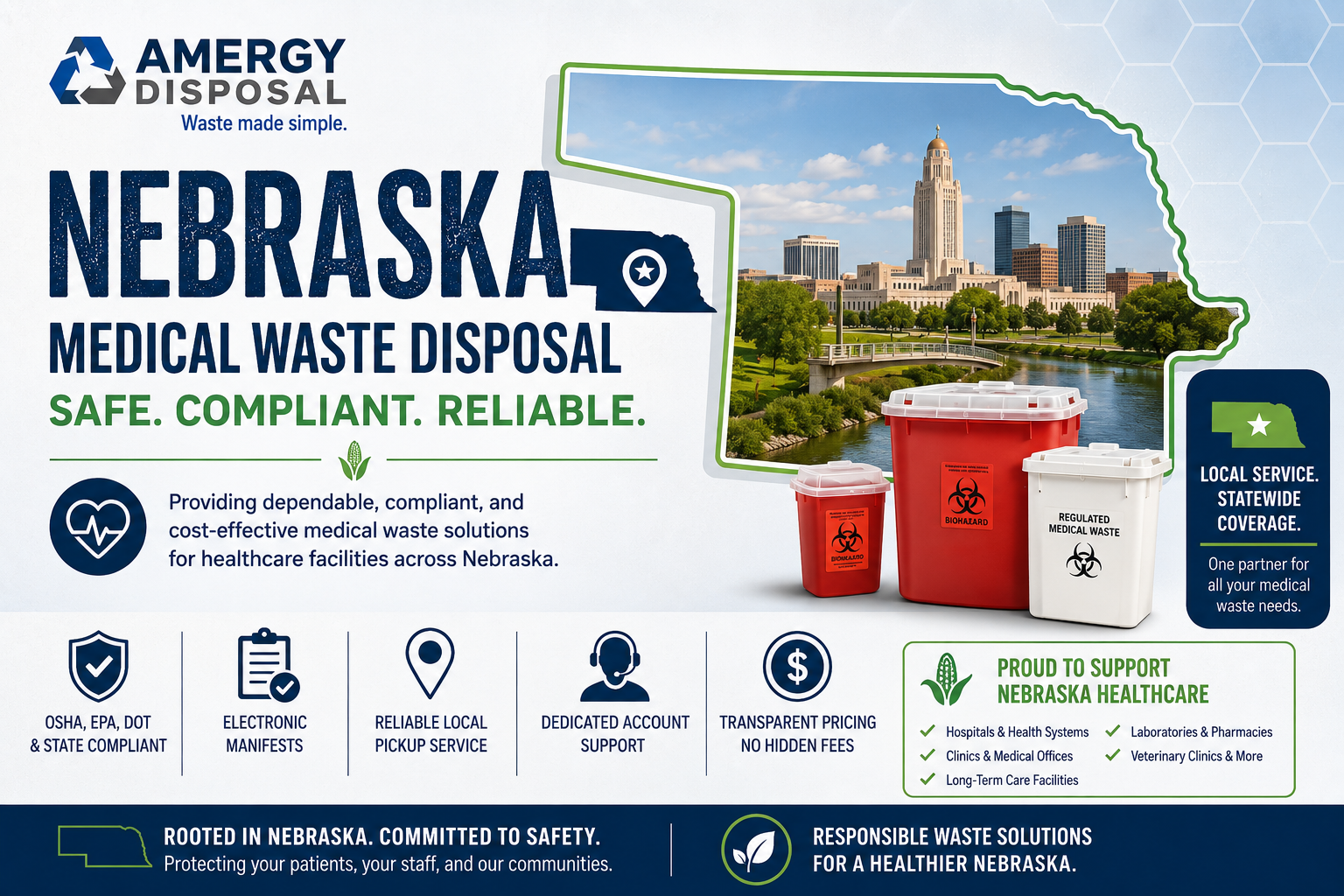
Nebraska Medical Waste Disposal, Made Simple and More Affordable
Across the Cornhusker State, healthcare facilities are cutting compliance costs and eliminating disposal headaches. Here is how proper Nebraska medical waste disposal keeps your practice NDEE Title 132-compliant while saving thousands every year.
Nebraska medical waste disposal is more than a routine pickup. Instead, it is a legal obligation that protects your staff, your patients, and the communities from the Panhandle to the Missouri River. From a busy Omaha hospital to a rural clinic outside Valentine, moreover, every generator of regulated waste in Nebraska must follow specific handling, treatment, and disposal rules. Consequently, choosing the right disposal partner is one of the smartest financial and compliance decisions a Nebraska facility can make. Above all, Amergy Disposal helps hundreds of businesses stay compliant while trimming costs that legacy haulers quietly inflate year after year.
In this guide, therefore, we break down exactly what Nebraska requires, how much you could save, and where Amergy is already helping facilities across the state. Additionally, we include the local agency phone numbers, the state-specific requirements, and a few fun facts you probably did not know about waste in Nebraska. Meanwhile, if you would rather skip ahead, you can request a free quote right now.
The Bottom LineHow Nebraska Businesses Are Saving Thousands
Medical waste contracts are notorious for hidden fees. Specifically, legacy vendors bury automatic price increases, fuel surcharges, environmental fees, and long-term auto-renewal clauses inside the fine print. As a result, a facility that signed at a fair rate five years ago may now be overpaying by 30% to 50% without ever agreeing to it. Meanwhile, the invoices keep climbing.
Amergy, in contrast, takes the opposite approach. Notably, we offer transparent, flat-rate pricing with no surprise surcharges and no punishing multi-year lock-ins. Therefore, Nebraska facilities that switch typically see immediate, measurable savings. In fact, many practices recover thousands of dollars annually simply by right-sizing pickup frequency and eliminating the “phantom fees” their old hauler was charging.
10 Nebraska Businesses That Generate the Most Medical Waste
Not every facility produces the same volume of regulated waste. Notably, the ten business types below generate the highest volumes across Nebraska; as a result, they have the most to gain from smarter Nebraska medical waste disposal. Meanwhile, the estimated monthly savings reflect typical reductions when switching from a legacy national hauler to Amergy.
| Business Type | Why Volume Is High | Est. Monthly Savings |
|---|---|---|
| Hospitals & Academic Medical Centers | 24/7 surgical, ER, and inpatient waste streams | $800 – $2,400 |
| Surgical & Ambulatory Centers | High sharps and single-use instrument volume | $450 – $1,300 |
| Dialysis Clinics | Bloodlines, filters, and daily treatment waste | $400 – $1,100 |
| Critical Access & Rural Hospitals | Small facilities paying big-hauler minimums | $300 – $950 |
| Dental Practices | Extracted teeth, sharps, and infectious materials | $150 – $600 |
| Long-Term Care & Nursing Homes | Continuous resident care and sharps | $300 – $900 |
| Physician & Urgent Care Clinics | High patient throughput, vaccines, sharps | $200 – $700 |
| Cattle & Livestock Veterinary Clinics | Nebraska’s ranching economy drives animal-care waste | $200 – $750 |
| Medical & Clinical Laboratories | Cultures, stocks, and pathological waste | $350 – $1,000 |
| Meatpacking & Plant Health Clinics | On-site occupational care at processing facilities | $180 – $700 |
Estimates are illustrative and vary by facility size, pickup frequency, and current contract terms. Request a free quote for figures specific to your operation.
The RulesNebraska Medical Waste Laws & Regulations
Nebraska medical waste disposal runs primarily through one agency and one core rulebook. Specifically, the Nebraska Department of Environment and Energy (NDEE) regulates infectious waste as a special waste under Title 132, the state’s Integrated Solid Waste Management Regulations. Furthermore, federal OSHA and DOT rules apply on top. Consequently, understanding how Title 132 defines and handles infectious waste is the foundation of compliance.
One Agency, One Core Rulebook
Unlike many states, Nebraska does not split medical waste oversight across several competing agencies. Instead, NDEE administers the framework, and it was formed in 2019 when the former Department of Environmental Quality merged with the state energy office. As a result, most compliance questions in Nebraska trace back to a single, consistent source.
How Nebraska Defines Infectious Waste
Notably, Nebraska draws a clear line between ordinary medical waste and infectious waste. Specifically, Title 132, Chapter 1, §053 defines infectious waste as solid waste capable of causing an infectious disease, based on the presence of a pathogen, a sufficient dose, and a viable portal of entry into a susceptible host. Meanwhile, most everyday medical waste is not dangerous and may go to a permitted landfill like ordinary solid waste. Therefore, the crucial question is always whether the waste can actually transmit disease.
Key Nebraska Regulatory References
- Title 132 — the Integrated Solid Waste Management Regulations, NDEE’s core framework.
- Title 132, Chapter 1, §053 — the regulatory definition of infectious waste.
- Nebraska Integrated Solid Waste Management Act — the statute behind the regulations.
- OSHA 29 CFR 1910.1030 — the federal Bloodborne Pathogens Standard for worker protection.
Medical Waste Requirements Unique to Nebraska
While much of medical waste regulation is federal, Nebraska layers on several state-specific expectations that facilities must know. Consequently, a compliance program built for another state will not automatically satisfy NDEE.
Render It Non-Infectious Before the Landfill
First, and most distinctively, Nebraska bars infectious waste from any solid waste disposal area unless it has first been rendered non-infectious. Specifically, accepted methods include incineration, autoclaving, or another effective treatment. Moreover, only after treatment may the material enter a permitted municipal solid waste landfill. Therefore, untreated infectious waste in the trash is never an option.
The Generator Makes the Call
Next, Nebraska places the infectious-versus-non-infectious determination squarely on the generator. In particular, each facility must evaluate its own waste against the Title 132 definition. As a result, staff training and consistent classification matter enormously, since a misjudgment can turn into a compliance problem quickly.
Determine Hazardous Waste First
Furthermore, Nebraska expects a hazardous waste determination before treatment. Specifically, hazardous waste may not be autoclaved or incinerated without a proper treatment, storage, and disposal facility permit. Consequently, certain chemotherapy and pharmaceutical wastes must be separated out before any infectious waste treatment step. Therefore, sequencing your waste review correctly protects you from an expensive mistake.
Households Are Handled Differently
Finally, Nebraska treats home-generated medical waste differently from facility waste. Specifically, household sharps and similar items are generally considered ordinary solid waste and may go to a permitted landfill, though safe containment is still encouraged. Meanwhile, waste generated in the common areas of assisted living and similar facilities is regulated more strictly. As a result, where the waste originates changes how it must be handled.
Your PartnerHow Amergy Helps Nebraska Businesses Stay Compliant
Staying compliant with Nebraska medical waste disposal rules does not have to be complicated or expensive. In fact, Amergy is built to remove the burden entirely. Accordingly, here is how we protect Nebraska facilities:
- Title 132 alignment — service that satisfies NDEE’s infectious waste framework and federal rules at once.
- Verified treatment — incineration or autoclaving that renders waste non-infectious before disposal.
- Correct sequencing — hazardous waste determinations handled before any treatment step.
- Compliant containers — red, biohazard-labeled, leak-resistant, puncture-proof supplies delivered to your door.
- Panhandle-to-Missouri-River coverage — scheduling that works for metro hospitals and rural clinics alike.
- Transparent pricing — flat rates with no surprise fuel or environmental surcharges.
Curious how the rules differ once you cross into Iowa, Kansas, or Colorado? Meanwhile, you can compare neighboring requirements on our medical waste disposal blog, which covers states across the country.
Every Amergy Customer Gets Our Online Safety & Compliance Portal
Compliance is not just about pickups. Rather, it is about proof. Accordingly, every Amergy customer receives free access to our online Safety & Compliance Portal, a secure hub for OSHA training, digital manifests, disposal records, and required documentation. As a result, when an NDEE inspector asks, your entire compliance history is a click away. Moreover, the portal keeps your team trained, your records organized, and your facility inspection-ready year-round.
20 Nebraska Cities Where Amergy Keeps Customers Compliant
Amergy provides Nebraska medical waste disposal across the Cornhusker State — from the western Panhandle to the Missouri River valley. Below, therefore, are the 20 most populous Nebraska communities where we help healthcare facilities stay compliant and save money.
Do not see your town listed? Regardless, Amergy serves communities of every size across Nebraska. Contact us for a free quote and we will confirm coverage for your location.
Local ResourcesNebraska Regulatory & Business Contacts
Keep these Nebraska agency contacts handy for questions about permits, waste classification, and compliance. Of course, for hands-on disposal help, Amergy is always just a phone call away.
Nebraska Fun Facts: Waste, Health & the Cornhusker State
The Cornhusker Standard
Nebraska sits atop the vast Ogallala Aquifer, one of the largest groundwater sources on Earth — a big reason the state guards how waste reaches its land and water.
One Agency, Merged in 2019
NDEE was created in 2019 when the Department of Environmental Quality merged with the state energy office, consolidating oversight under one roof.
Pathogen, Dose, Portal
Nebraska’s definition of infectious waste turns on three things together: a pathogen, a sufficient dose, and a viable portal of entry into a host.
Treat, Then Landfill
Infectious waste must be autoclaved, incinerated, or otherwise rendered non-infectious before it can ever enter a permitted Nebraska landfill.
Ranch Country Waste
With cattle outnumbering people several times over, Nebraska’s veterinary and livestock sector generates a steady stream of regulated animal-care waste.
Home Waste Is Different
Household medical waste is generally treated as ordinary solid waste in Nebraska, while facility-generated waste faces far stricter handling rules.
Simplify Nebraska Medical Waste Disposal With Amergy
Compliance You Can Prove
From Title 132’s treatment rules to OSHA’s labeling standards, Nebraska medical waste disposal comes with real obligations. Fortunately, however, Amergy handles them for you — with compliant containers, verified treatment, and a Safety & Compliance Portal that keeps you audit-ready.
Savings You Can Measure
Legacy haulers thrive on hidden fees and locked-in contracts. Amergy, by contrast, does the opposite. As a result, Nebraska facilities routinely save thousands of dollars a year after switching — without sacrificing reliability.
Service You Can Trust
From Omaha to Scottsbluff, Amergy is already helping Nebraska businesses stay compliant and spend less. Ultimately, waste should be one less thing you worry about. Therefore, let us make it simple.