
Medical Waste Compliance
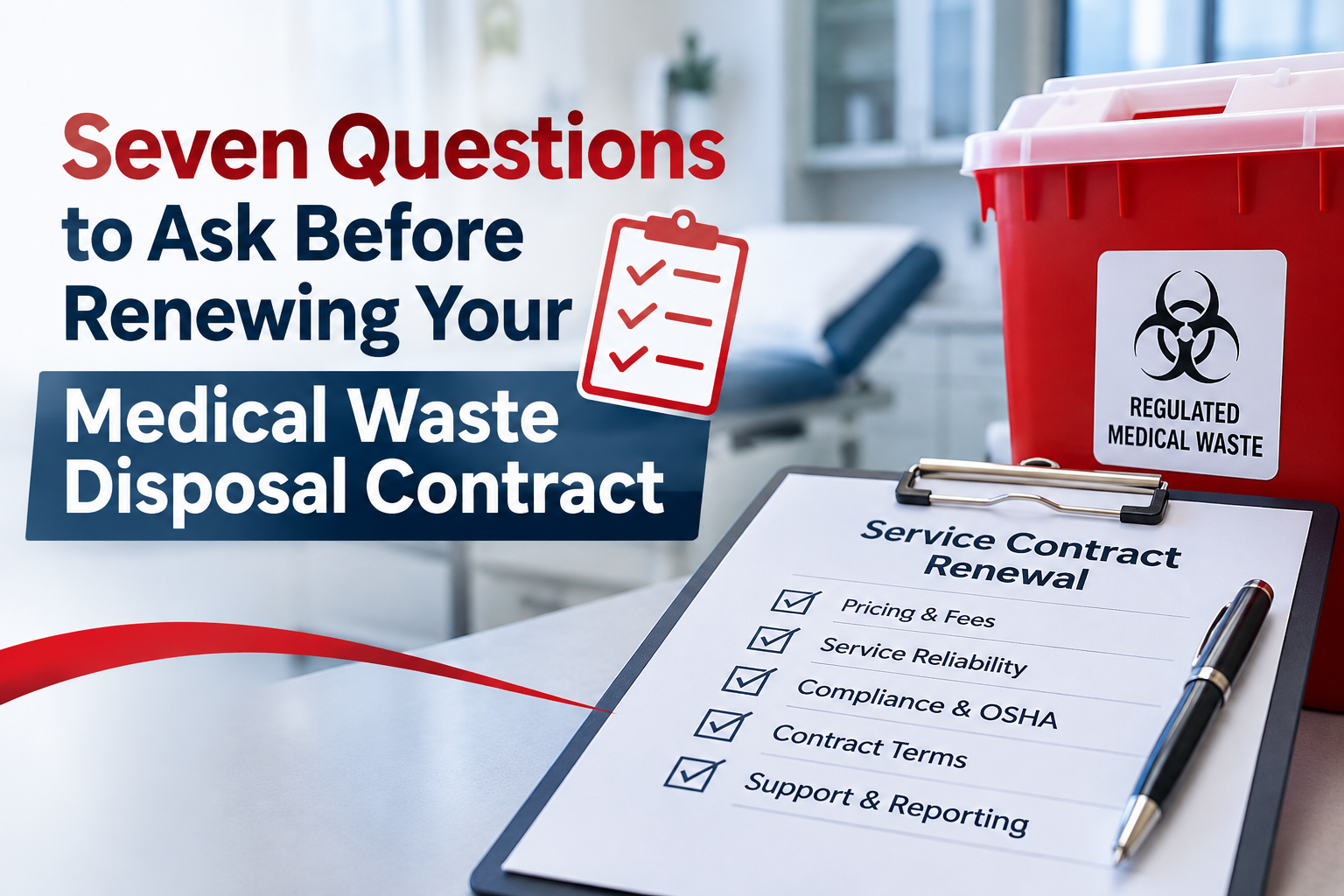
10 Questions to Ask Before Renewing Your Medical Waste Contract
Your renewal date is the one time you have real leverage. Here is how to use it.
Most practices sign a medical waste contract and forget about it. Then the renewal date passes, the price goes up, and they are locked in for three more years.
It does not have to go that way. Before you renew your medical waste contract, take an hour to review it with the questions below. They cover pricing, fees, auto-renewal terms, compliance support, and liability. Each one can save you money or protect you during an inspection.
1. When Does My Medical Waste Contract Renew, and How Do I Cancel?
Look for the auto-renewal clause and the notice period before anything else.
Many agreements include an evergreen clause. It renews the contract automatically unless you cancel in writing by a set date. That window is often 60 to 90 days before the term ends. Some contracts renew for the full original term, which can be three to five years.
Find these details and put them on your calendar:
- The exact end date of the current term
- The cancellation notice deadline
- How notice must be sent (certified mail, email, a specific address)
- The length of the renewal term
2. What Am I Actually Paying For?
Your base rate is rarely your real cost. Fees and surcharges often add a large share of the bill.
Pull your last six to twelve invoices. Then compare them to the contract. Look for line items like these:
- Fuel surcharges
- Environmental, energy, or regulatory compliance fees
- Container rental or replacement fees
- Stop, trip, or service call fees
- Overweight or overfill charges
- Minimum monthly billing, even when you have no pickup
Ask the vendor to explain each fee and how it is calculated. If they cannot explain it clearly, that is a red flag. A fair medical waste disposal contract should let you predict your bill.
3. How Can My Price Change During the Term?
Check for price escalator language and ask for a cap.
Many contracts let the vendor raise prices once a year. Some tie increases to an index like the Consumer Price Index. Others allow increases “at the vendor’s discretion.” That last phrase gives you almost no protection.
At renewal, you can ask for:
- A fixed rate for the full term
- A firm annual cap, such as 3 percent
- Written notice at least 30 days before any increase
- The right to cancel if prices rise beyond the cap
4. What Does It Cost to Leave Early?
Read the early termination and liquidated damages sections closely.
Some vendors charge a percentage of the remaining contract value. Others charge several months of your average bill. On a long term, that can add up fast. It can also trap you with a vendor whose service has slipped.
Ask whether you can leave without penalty if the vendor misses pickups or fails to deliver required paperwork. A strong contract should hold both sides accountable.
5. Do My Service Frequency and Containers Still Fit My Volume?
Your waste volume changes. Your service plan should change with it.
Maybe you added providers. Maybe you closed a location or shifted to more telehealth visits. Any of these can change how much waste you produce.
If you pay for weekly pickups but your containers are half full, you are overpaying. If containers overflow before pickup, you may face overfill fees and storage issues. Review container sizes and pickup frequency against your real numbers before you renew.
6. Does the Contract Cover All of My Waste Streams?
Make sure every type of waste you generate is listed and priced.
Regulated medical waste is not one category. Depending on your facility, you may generate:
- Sharps
- Red bag biohazardous waste
- Pathological waste
- Trace chemotherapy waste
- Non-hazardous pharmaceutical waste
- Hazardous pharmaceutical waste under the EPA’s hazardous waste pharmaceuticals rule
- Amalgam, film, or other specialty waste
If a stream is missing, you may be paying a second vendor or handling it wrong. Both are problems. One vendor that covers every stream keeps things simpler and easier to document.
7. What Compliance Support Is Included?
Disposal is only half the job. Your vendor should help you stay inspection-ready.
Ask what comes with the service at no extra cost:
- Tracking documents or manifests for every pickup
- Certificates of treatment or destruction
- Online access to your records
- OSHA training for your staff
- Help with state-specific rules
Training matters more than many practices realize. The OSHA Bloodborne Pathogens Standard (29 CFR 1910.1030) requires annual training for employees with occupational exposure. If your vendor offers it, that is one less thing to manage on your own.
Also ask how long the vendor keeps records. Some states require you to hold them for several years. You want to be able to pull them quickly if an inspector asks.
8. Who Is Liable If Something Goes Wrong?
In most cases, your facility stays responsible for its waste until it is properly treated.
This is often called “cradle to grave” responsibility. If your hauler mishandles or illegally dumps waste, regulators can trace it back to you. That is why the fine print on liability deserves a close read.
Ask your vendor these questions:
- What insurance do you carry, and can I see a certificate?
- Does the indemnification clause protect me, or only you?
- Where is my waste treated, and who owns that facility?
- Are your drivers trained for DOT hazardous materials transport?
9. What Service Levels Are Guaranteed?
A good contract spells out what happens when service fails.
Missed pickups cause real problems. Waste piles up. Storage limits get stretched. Staff spend time on the phone instead of with patients.
Look for clear terms on:
- How fast a missed pickup will be fixed
- Who your single point of contact is
- How quickly calls and emails get answered
- Credits or remedies when the vendor falls short
If none of this is in writing, ask for it before you renew.
10. Can I Get One Agreement for Every Location?
If you run more than one site, consolidating can cut costs and paperwork.
Multi-location groups often end up with a mix of vendors, rates, and renewal dates. That makes it hard to track spending and harder to stay compliant. One national provider with one agreement gives you consistent pricing, one set of records, and one team to call.
Ask whether the vendor can serve all of your locations. Also ask whether new sites can be added at the same rates.
Medical Waste Contract Renewal Checklist
Use this quick checklist when you sit down with your agreement.
| Item to Check | What to Look For |
|---|---|
| Renewal date and notice period | Calendar the deadline. Note how notice must be sent. |
| Auto-renewal clause | Length of the new term and how to opt out. |
| All fees and surcharges | Every fee explained in writing with its formula. |
| Price increase terms | Fixed rate or a firm annual cap. |
| Early termination | Penalty amount and exit rights for poor service. |
| Service frequency and containers | Matches your current volume. |
| Waste streams covered | Every stream you generate is listed and priced. |
| Compliance documents | Manifests, certificates, and online records included. |
| Training | OSHA training offered and documented. |
| Insurance and indemnification | Certificate on file. Mutual protection. |
| Service guarantees | Missed pickup fixes and a named contact. |
| Location coverage | All current and future sites at the same terms. |
How Amergy Approaches Medical Waste Contracts
At Amergy Disposal, we believe your medical waste contract should be easy to read and easy to predict. Our motto is simple: Waste made simple!
We serve healthcare facilities in all 50 states. That includes medical and dental practices, clinics, surgery centers, labs, and multi-location groups. We handle the full range of regulated waste streams under one agreement.
We also offer OSHA compliance training led by instructors who hold the C.O.S.S. (Certified Occupational Safety Specialist) credential. That way your team gets disposal and training from one partner.
Frequently Asked Questions
When should I start reviewing my medical waste contract before renewal?
Start at least 90 to 120 days before the end date. Many medical waste contracts require 60 to 90 days of written notice to cancel. If you miss that window, an auto-renewal clause can lock you into another full term.
What is an auto-renewal clause in a medical waste contract?
An auto-renewal clause, also called an evergreen clause, renews your agreement for a new term unless you cancel in writing by a set deadline. Some renew for the full original term, often three to five years.
What hidden fees show up on medical waste invoices?
Common add-ons include fuel surcharges, environmental or energy fees, regulatory compliance fees, container rental, stop or trip fees, overweight charges, and minimum monthly billing. Ask for every fee in writing with how it is calculated.
Am I still liable for medical waste after the hauler picks it up?
In most cases, yes. The generator usually stays responsible for waste until it is properly treated and disposed of. That is why manifests, certificates of destruction, and vendor insurance matter.
Can I switch medical waste companies before my contract ends?
Usually, but it may cost you. Read the early termination and liquidated damages sections. Some contracts charge a percentage of the remaining value. Others charge a flat number of months of average billing.
Renewal Coming Up? Let’s Review It Together.
Send us your current medical waste contract. We will walk through it with you and show you what a simpler agreement could look like.
Talk to Amergy