
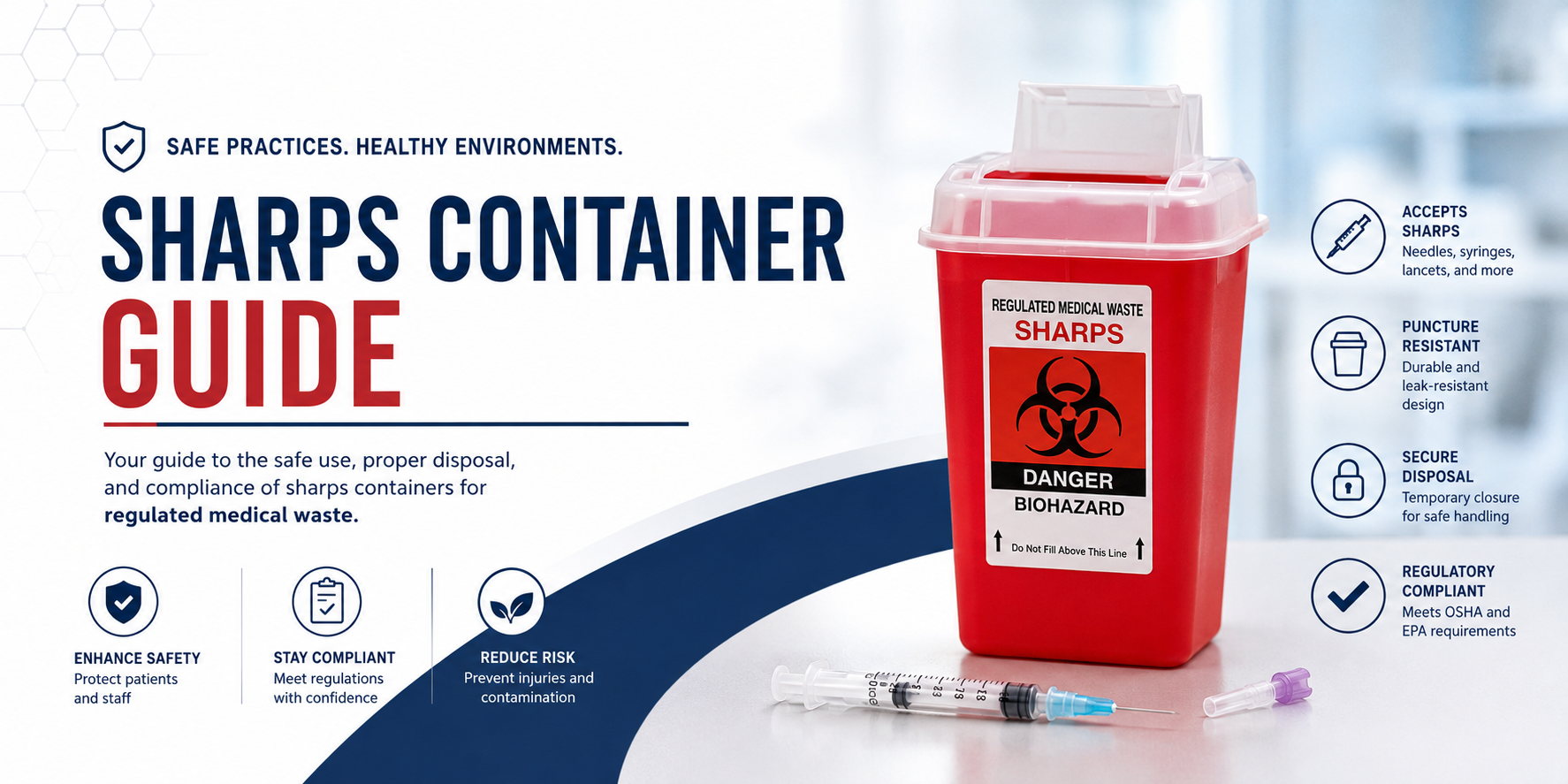
The Ultimate Sharps Container Guide:
Types, Sizes, Regulations & Safe Disposal
Everything healthcare providers, businesses, and home users need to know about FDA-cleared sharps containers and OSHA-compliant disposal.
What Is a Sharps Container?
A sharps container is a rigid, puncture-resistant vessel specifically engineered to safely store used needles, syringes, lancets, auto-injectors, and other sharp medical implements until they can be professionally disposed of. Unlike ordinary household bins, a regulated sharps container is engineered to prevent accidental needlestick injuries — one of healthcare’s most preventable occupational hazards.
The term “sharps” encompasses any device that can pierce or cut skin: hypodermic needles, insulin pen needles, lancets used for blood glucose monitoring, IV catheters, scalpels, and even broken glass from vials. When improperly discarded, these items pose serious risks of transmitting bloodborne pathogens including HIV, hepatitis B, and hepatitis C.
Per OSHA’s Bloodborne Pathogens Standard (29 CFR 1910.1030), a sharps container must be closable, puncture-resistant, leak-proof on sides and bottom, and labeled with the biohazard symbol or color-coded red.
Whether you manage a busy surgical suite, run a veterinary clinic, operate a tattoo studio, or are a diabetic patient at home, understanding sharps containers is not just good practice — in most settings, it is a legal requirement.
Types of Sharps Containers
Sharps containers are not one-size-fits-all. The market offers a wide variety of configurations, each designed for a specific clinical environment, sharps volume, or user population.
1. Horizontal Entry Containers
These containers feature a horizontal drop-in opening that prevents sharps from protruding back out. They are commonly used for loose needles and lancets in clinical settings. The sideways slot reduces the risk of reaching in and making contact with a needle that is partially exposed.
2. Vertical Drop Containers
The most common design, featuring a top-mounted opening for dropping sharps directly into the container. Most desktop and countertop models use this configuration. Many include a needle-detachment port so the barrel does not need to go into the sharps bin.
3. Bracket-Mounted Wall Containers
Designed to mount at the point of care — beside exam tables, IV stations, or phlebotomy chairs — bracket-mounted models keep sharps disposal within arm’s reach, dramatically reducing the likelihood of a needlestick from carrying a used sharp across the room.
4. In-Room Collection Containers (Floor-Standing)
For high-volume areas such as surgical suites, emergency departments, or dialysis centers, large floor-standing containers (8–18 gallon) collect significant volumes of sharps between service intervals. These units typically include locking lids for full containers.
5. Mail-Back Sharps Disposal Systems
FDA-cleared mail-back systems provide a convenient disposal route for home users, rural clinics, or small generators that don’t have access to on-site medical waste pickup. The sharps container ships prepaid to an approved treatment facility once full. Amergy’s mail-back service covers patients and small businesses across the continental United States.
6. Reusable (Temporary) Sharps Containers
Some programs offer reusable outer containers with disposable inner liners. These are common in high-volume settings where the outer casing is sterilized and re-used, while the liner containing the sharps is incinerated. They reduce plastic waste but require careful protocol adherence.
Sharps Container Sizes: Choosing the Right Capacity
Selecting the correct container size is critical for maintaining compliance and staff safety. A container that fills too quickly creates unnecessary swap-outs; one that is too large may sit in service longer than regulations allow.
| Size | Capacity | Typical Use Case | Exchange Frequency |
|---|---|---|---|
| Pocket / Travel | 0.5 qt / 0.5 L | Home diabetic patients, travel | As needed |
| Desktop Small | 1 qt / 1 L | Exam rooms, home self-injection | Weekly–Monthly |
| Desktop Medium | 2 qt / 2 L | Physician offices, dental, vet | Monthly |
| Desktop Large | 3–5 qt / 3–5 L | Busy clinics, urgent care | Bi-weekly–Monthly |
| In-Room Medium | 8 gal / 30 L | OR suites, procedure rooms | Weekly |
| Floor-Standing Large | 18 gal / 68 L | Dialysis, hospital wards | Weekly–Bi-weekly |
Never fill a sharps container past the fill line — typically 75% capacity. Overfilling is one of the leading causes of needlestick injuries during disposal and may constitute an OSHA violation.
OSHA & FDA Regulations for Sharps Containers
Sharps container compliance is governed by two overlapping federal frameworks — OSHA’s workplace safety requirements and the FDA’s device classification rules — as well as state-specific regulations that can be more stringent than federal minimums.
OSHA Bloodborne Pathogens Standard (29 CFR 1910.1030)
Any workplace where employees have reasonably anticipated occupational exposure to blood or other potentially infectious materials (OPIM) must comply with OSHA’s Bloodborne Pathogens Standard. This includes:
- Immediately placing contaminated sharps in an FDA-cleared sharps disposal container at the point of use
- Containers must be closable, puncture-resistant, leak-proof, and labeled or color-coded
- Containers must be maintained upright, routinely replaced, and not allowed to be overfilled
- Employees must not recap, bend, shear, or purposely break contaminated needles by hand
FDA Classification (21 CFR 880.6230)
The FDA classifies sharps containers as Class II medical devices under 21 CFR Part 880. This means manufacturers must demonstrate substantial equivalence to a predicate device through a 510(k) premarket notification. Always verify that any container you purchase carries FDA clearance — this is both a regulatory requirement and a critical quality signal.
EPA and DOT Requirements
Once a sharps container is sealed and ready for transport, it becomes regulated medical waste subject to EPA and Department of Transportation (DOT) rules. Packaging, labeling, and manifesting requirements apply to generators, transporters, and treatment facilities. A professional disposal partner like Amergy Disposal manages all downstream compliance on your behalf.
Partnering with a licensed medical waste provider covers your OSHA, EPA, and DOT obligations with a single service agreement and provides the documentation trail needed during regulatory inspections.
State-by-State Sharps Regulations
While federal OSHA and FDA rules set the floor, many states impose additional requirements on healthcare facilities and, increasingly, on home users. Here is a summary of key considerations by region:
| State / Region | Home User Rules | Facility Requirements | Mail-Back Allowed |
|---|---|---|---|
| California | Strict – must use approved containers; household trash banned | Full OSHA + Cal/OSHA overlay | ✓ |
| New York | Drop-box or mail-back required | DOH-licensed hauler mandatory | ✓ |
| Texas | Clip/cap program or mail-back | TCEQ registered vendor | ✓ |
| Florida | Approved container; no household trash | AHCA-licensed vendor | ✓ |
| Rural States | Varies widely; check state DOH | Federal minimum typically applies | ✓ |
Regulations change frequently. We strongly recommend verifying current requirements with your state Department of Health or a compliance specialist before making disposal decisions.
How to Use a Sharps Container Correctly
Even the highest-quality container offers limited protection when used improperly. Follow these evidence-based best practices to maximize sharps safety in your facility or home.
Place at the Point of Use
Position the container within arm’s reach of wherever sharps are administered. Carrying used sharps across a room is one of the most common causes of accidental needlesticks.
Dispose Immediately After Use
Drop sharps into the container immediately after use — never set them down on a counter, tray, or bed surface to be disposed of later. One-handed scoop technique is acceptable only for recapping during multi-use procedures.
Never Overfill
Seal and replace the container when waste reaches the manufacturer’s fill line (75% capacity). Never compress, shake, or reach into the container to make more room.
Secure the Lid Before Removal
Use the container’s locking mechanism (temporary or permanent closure) before handing the full container off for disposal. Most containers have a two-stage lid: a temporary cap for transport within a facility, and a final lock for disposal.
Label and Store Securely
Sealed containers awaiting pickup must be stored in a secure, designated area inaccessible to unauthorized personnel, patients, children, or animals. They should remain upright and at room temperature.
Schedule Regular Pickup
Work with a licensed medical waste hauler on a service schedule that prevents containers from accumulating. Most facilities schedule monthly or bi-weekly pickup; high-volume settings may require weekly service.
Sharps Disposal Options: Which Is Right for You?
Choosing the right disposal method depends on your setting, sharps volume, geography, and budget. Here is a comparison of the four primary options available to U.S. generators.
| Method | Best For | Cost | Documentation | OSHA Compliant |
|---|---|---|---|---|
| Licensed Medical Waste Hauler | Healthcare facilities, any volume | $$ – $$$ | ✓ Full | ✓ |
| Mail-Back Service | Home users, rural clinics, low volume | $ | ✓ Certificate | ✓ |
| Hospital / Pharmacy Drop-Off | Home patients only | Free – $ | ✗ None | Home use only |
| Household Trash (most states) | Nobody — illegal in most states | — | ✗ | ✗ |
For most healthcare facilities, a licensed medical waste hauler is the only option that provides the full compliance documentation required during OSHA inspections, Joint Commission surveys, or state health department audits. Services like Amergy Disposal provide a waste manifest, certificate of destruction, and dedicated account management — eliminating compliance guesswork.
Sharps Container Guide for Home Users
An estimated 8 million Americans self-inject medications at home — for diabetes, rheumatoid arthritis, multiple sclerosis, fertility treatments, and more. Many are unaware that tossing a used syringe into the kitchen trash is illegal in most states and poses a serious risk to sanitation workers, children, and pets.
Home Sharps Disposal: Step-by-Step
- Use an FDA-cleared container from day one. These are available at most pharmacies for under $15 or free through some insurance programs and drug manufacturers.
- Never clip, bend, or recap needles before disposal — this dramatically increases injury risk.
- Seal the container when 75% full. Do not overfill.
- Check your state’s approved disposal methods — options include mail-back programs, community drop boxes at pharmacies, and some household hazardous waste events.
- Never place a sealed sharps container into a recycling bin or household trash unless your state explicitly permits this with approved containers.
Sanitation workers suffer thousands of sharps injuries annually from improperly discarded containers. A $12 sharps container and a mail-back envelope protect your family and your community’s waste management workers.