
What Is a Sharps Injury Log — and Does Your Facility Have One?
OSHA mandates this document under the Bloodborne Pathogens Standard. Most small clinics have never heard of it — and the fines for non-compliance can exceed $16,000 per violation.
If you manage a medical clinic, dental practice, urgent care center, or any healthcare facility — there is a federally required document sitting in your compliance checklist that most small practices have never created. It is called the sharps injury log, and OSHA can cite you for not having one.
This guide explains exactly what a sharps injury log is, who is legally required to maintain one, what it must contain, how long you must keep it, and what happens if you don’t comply.
A sharps injury log is not optional. It is required by federal law under OSHA’s Bloodborne Pathogens Standard (29 CFR 1910.1030). Non-compliance can result in citations and fines exceeding $16,000 per violation.
What Is a Sharps Injury Log?
A sharps injury log is a written record that healthcare employers are required to maintain documenting every instance in which an employee is injured by a sharp medical device. This includes needlestick injuries, cuts from scalpels, lancet punctures, broken glass, and any other sharp instrument capable of penetrating the skin and potentially exposing a worker to bloodborne pathogens.
The sharps injury log was formally established as a requirement under the Needlestick Safety and Prevention Act of 2000, which amended OSHA’s Bloodborne Pathogens Standard to include more detailed recording requirements for needlestick and sharps injuries specifically — separate from the general OSHA 300 illness and injury log.
The distinction matters: while serious needlestick injuries may also appear on your OSHA 300 Log, the sharps injury log is a separate, dedicated document with its own specific data requirements and confidentiality protections.
Who Is Required to Keep a Sharps Injury Log?
The OSHA Bloodborne Pathogens Standard applies to any employer whose workers may be exposed to blood or other potentially infectious materials (OPIM) through contact with sharps. This is not limited to hospitals and large health systems.
The following facility types are required to maintain a sharps injury log:
There is no minimum employer size exemption for the sharps injury log requirement. Even a solo practitioner with a single employee who handles sharps must comply with this OSHA standard.
What Must a Sharps Injury Log Include?
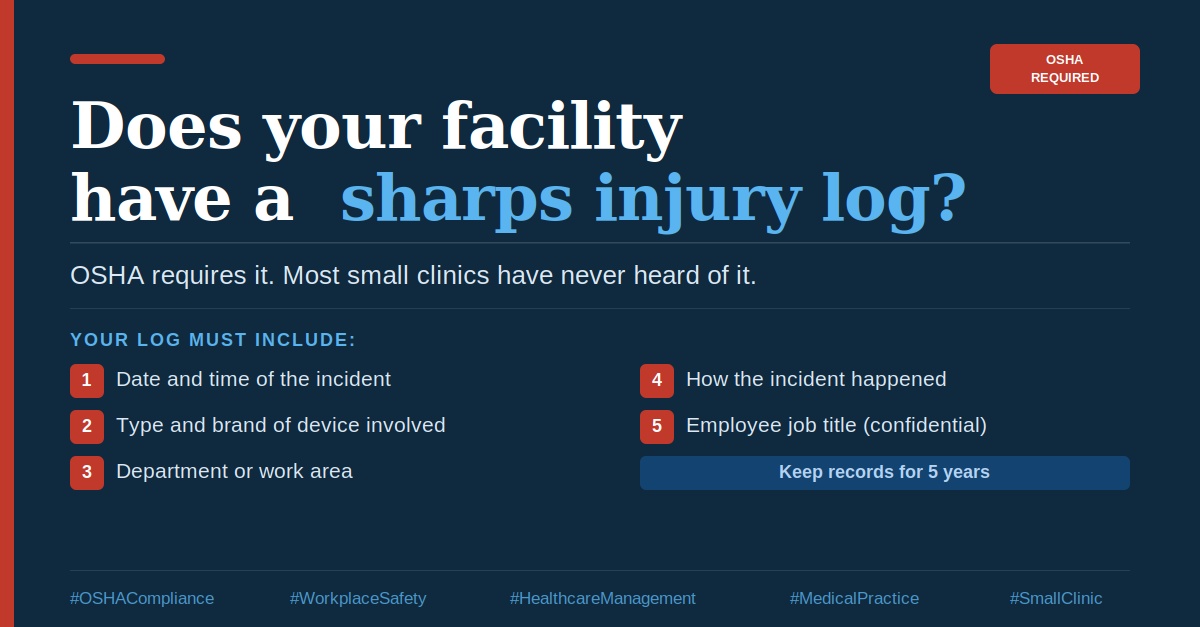
OSHA specifies the exact information that must be captured in every sharps injury log entry. The log must record the following five data points for each incident:
-
1
Date and time of the incident The exact date and approximate time the sharps injury occurred.
-
2
Type and brand of the device involved Identify the specific sharp (e.g., “22-gauge hypodermic needle, Brand X”) to help track device-related patterns.
-
3
Department or work area where the incident occurred The specific location within the facility — used to identify high-risk areas for targeted safety improvements.
-
4
Explanation of how the incident occurred A brief description of the circumstances — what procedure was being performed, what went wrong, and contributing factors.
-
5
Employee job title (not the employee’s name) OSHA requires the job title rather than the worker’s name to protect employee confidentiality. This is a critical distinction.
The sharps injury log must be maintained in a way that cannot be used to identify the injured employee. Employee names must never appear in this log. The log must be kept in a confidential manner and may only be disclosed as required by law.
How Long Must You Keep a Sharps Injury Log?
OSHA requires that sharps injury logs be retained for a minimum of five years following the end of the calendar year in which the entries were made. For example, a log created in 2024 must be kept until at least December 31, 2029.
The log must be made available to OSHA compliance officers upon request. It must also be made available to employees, employee representatives, and health professionals upon request, subject to privacy rules.
OSHA Penalties for Non-Compliance
Failure to maintain a sharps injury log — or maintaining one that does not meet OSHA’s requirements — constitutes a violation of the Bloodborne Pathogens Standard. OSHA penalty amounts are adjusted annually for inflation.
| Violation Type | Description | Maximum Penalty (2026) |
|---|---|---|
| Other-than-Serious | Minor violations with low injury risk | Up to $16,131 |
| Serious | Violations with substantial probability of harm | Up to $16,131 |
| Willful or Repeated | Intentional disregard or repeated non-compliance | Up to $161,323 |
| Failure to Abate | Ongoing violation after correction deadline | Up to $16,131/day |
Beyond financial penalties, OSHA violations become part of the public record and can affect a facility’s reputation, professional licensure standing, and eligibility for certain healthcare contracts and accreditations.
How to Create a Sharps Injury Log: Step-by-Step
Setting up a compliant sharps injury log for your facility does not require specialized software. Many facilities maintain this as a simple protected spreadsheet or dedicated paper binder. Here is how to get started:
- Designate a responsible party Assign a specific staff member — typically your compliance officer, office manager, or infection control coordinator — as the person responsible for maintaining and updating the log after every incident.
- Create your log template Set up a spreadsheet or form with columns for: Date, Time, Device Type & Brand, Work Area, Incident Description, and Employee Job Title. Do not include a column for employee name.
- Establish a reporting protocol Create a clear procedure for employees to report sharps injuries promptly. Staff must know who to report to and within what timeframe — ideally within 24 hours of the incident.
- Secure the document The log must be stored in a way that protects employee confidentiality. For paper logs, this means a locked cabinet. For digital logs, access controls are required.
- Review and analyze annually OSHA encourages employers to use the sharps injury log data to identify patterns, evaluate safer device options, and update their Exposure Control Plans accordingly.
- Retain for five years Archive completed logs. Clearly label them with the calendar year they cover and retain for a minimum of five years from the end of that year.
How the Sharps Injury Log Fits Into Your Exposure Control Plan
The sharps injury log is one component of a broader set of requirements under OSHA’s Bloodborne Pathogens Standard. Employers subject to the standard must also maintain a written Exposure Control Plan (ECP) — a comprehensive document that outlines how the facility identifies, evaluates, and controls occupational exposure to bloodborne pathogens.
Your Exposure Control Plan must be reviewed and updated at least annually, and data from your sharps injury log should directly inform that review. If your log reveals a pattern of injuries involving a specific type of device, your ECP must reflect the evaluation of safer engineered alternatives.
This is not just bureaucratic compliance — it is the mechanism by which OSHA intends for the data you collect to actually reduce injury rates over time.
Is your facility fully OSHA compliant?
A compliance gap assessment takes less than an hour and can save you from a five-figure citation. Start with a review of your sharps injury log, Exposure Control Plan, and Bloodborne Pathogens training records.
Request a Compliance ReviewFrequently Asked Questions
Is a sharps injury log the same as an OSHA 300 log?
No. They are separate documents. The OSHA 300 log records all work-related injuries and illnesses meeting certain severity thresholds. The sharps injury log is a dedicated record specifically for sharps-related incidents, and it captures more granular information including device type and brand. A single needlestick injury may need to be recorded in both documents depending on its severity.
What if we have had zero sharps injuries — do we still need a log?
Yes. Facilities subject to the Bloodborne Pathogens Standard must maintain a sharps injury log system even if no incidents have occurred. The log exists as a ready mechanism — the fact that it is empty confirms a clean record, not that the requirement doesn’t apply to you.
Can the sharps injury log be maintained electronically?
Yes. Electronic records are acceptable provided they can be produced in a readable format when requested and access is appropriately controlled to protect employee confidentiality. Many practice management and EHR systems include OSHA log modules.
Do part-time or temporary employees need to be included in the sharps injury log?
Yes. The Bloodborne Pathogens Standard protects all workers with occupational exposure, regardless of employment status. Any sharps injury sustained by a part-time, temporary, per diem, or contract worker while performing work for your facility must be documented in the log.
Who can request to see the sharps injury log?
OSHA compliance officers may request the log during an inspection. Employees, former employees, and their designated representatives may also request access. Health professionals responsible for evaluating and treating exposed employees may also be given access as needed. In all cases, the log must be provided in a way that protects confidentiality — personal identifiers must not be disclosed.
Bottom Line: Check Your Compliance Today
The sharps injury log is one of the most commonly overlooked OSHA requirements in small and mid-size healthcare settings. It is not complicated to implement — but the cost of not having one can be steep, both financially and in terms of the real-world risk to your staff if injury patterns go unidentified.
If you are unsure whether your facility has a compliant sharps injury log in place, treat that uncertainty as a “no” and act accordingly. Pull together your Bloodborne Pathogens documentation, review your Exposure Control Plan, and confirm that your incident reporting procedure is clearly communicated to all staff who handle sharps.
Compliance is not just about avoiding fines — it is about building a workplace where your team can care for patients without putting themselves at unnecessary risk.