
⚠ Utah requires waste stored longer than 7 days to be refrigerated at ≤40°F — and all storage beyond 60 days is strictly prohibited. Is your schedule compliant? Get a free Amergy check →
Utah Medical Waste Disposal:
Beehive State Compliance Made Simple
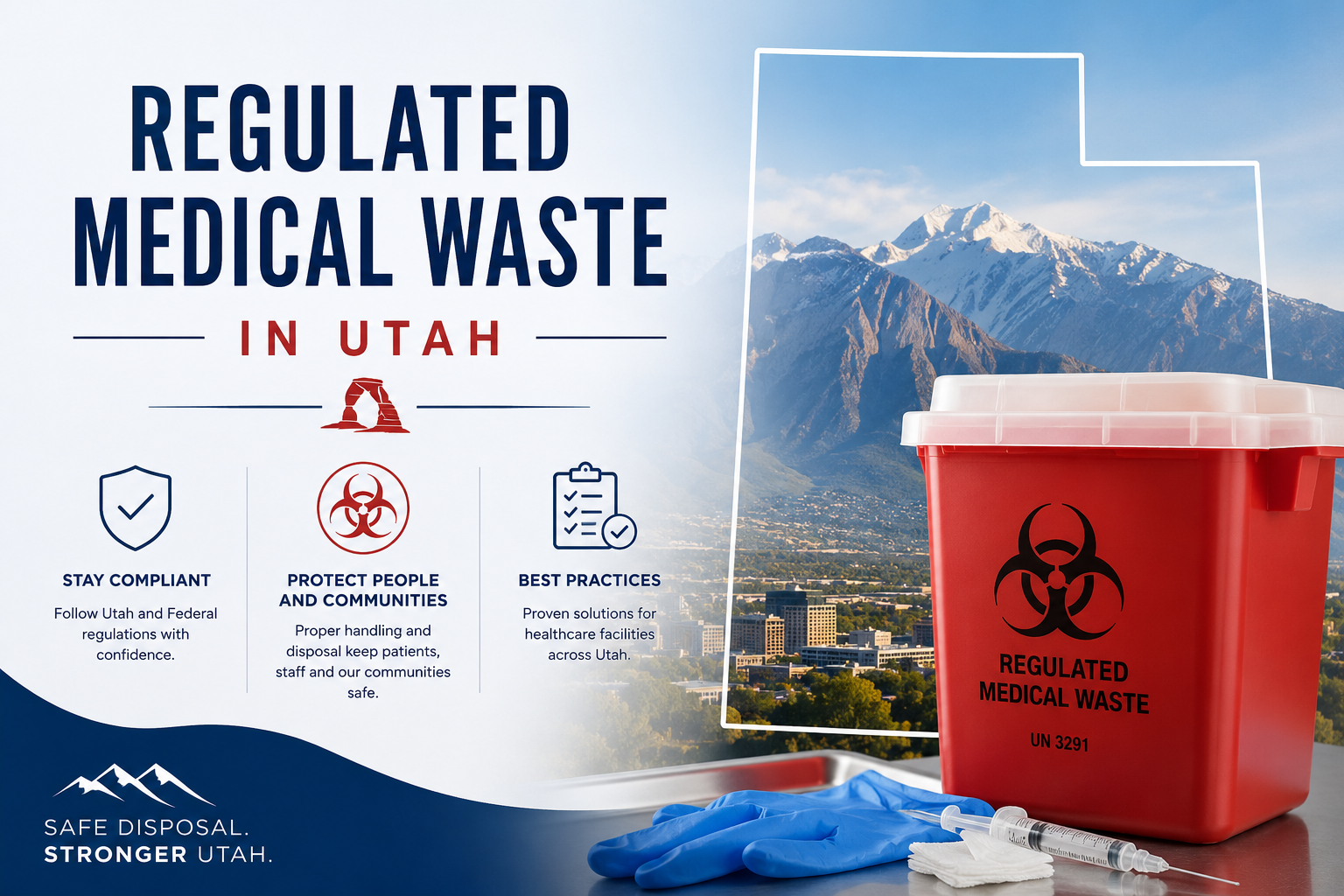
Utah’s DEQ enforces some of the most detailed infectious waste rules in the Mountain West — including strict temperature storage limits and a 200-pound threshold that determines your full compliance obligations. Amergy Disposal keeps Utah businesses protected across all 29 counties.
Utah Medical Waste Disposal: The Rules Every Beehive State Business Must Know
A Framework Built Around One Key Number
When it comes to Utah medical waste disposal, the most important number to know is 200 pounds per month. Specifically, Utah’s DEQ regulates facilities under Rule R315-316 based primarily on this threshold. Consequently, businesses that generate more than 200 pounds of infectious waste monthly face full large-generator compliance obligations, while those below that threshold have significantly reduced — though not eliminated — requirements.
Additionally, Utah uses the term “infectious waste” throughout its regulatory code, just as New Mexico does. Therefore, businesses relocating from states that use “medical waste” or “biohazardous waste” must update their labeling and documentation accordingly. Amergy Disposal helps Utah businesses navigate every aspect of this framework statewide.
Two Agencies, One Compliance Goal
Furthermore, Utah medical waste disposal falls under dual-agency oversight. Specifically, the Utah Department of Environmental Quality (DEQ) — through its Division of Solid and Hazardous Waste (DSHW) — administers Rule R315-316. In addition, the Utah Department of Health and Human Services (DHHS) provides guidance on public health concerns related to medical waste. As a result, generators must satisfy both agencies’ standards alongside federal OSHA and EPA requirements simultaneously.
🏔 Focus Keyphrase
Throughout this guide, we address Utah medical waste disposal compliance under DEQ Rule R315-316. Use the sidebar table of contents to jump directly to the section most relevant to your facility.
What Utah Calls “Infectious Waste” — The Full Definition
Utah DEQ’s Official Definition
Under DEQ’s official guidance for Rules 315-316, “infectious waste” is waste intended to include any material capable of producing an infectious disease. Moreover, the definition specifically covers used sharps, body fluids, materials mixed with body fluids, bandages, and other items that have contacted body fluids. Because this definition is intentionally broad, understanding it fully is therefore the essential first step in any Utah medical waste disposal compliance program.
Importantly, Utah additionally classifies waste containing blood and blood products, excretions, exudates, secretions, suctionings, and other body fluids — when they cannot be discharged directly into a municipal sewer — as infectious waste. Consequently, even small medical practices generate regulated waste on a daily basis.
Utah’s Regulated Waste Categories
- Used sharps — needles, syringes, blades, pipettes, blood vials, broken glass
- Body fluids — liquid or semi-liquid blood, secretions, and suctionings in excess of small amounts
- Contaminated materials — items saturated with blood or body fluids that would release liquid if compressed
- Pathological waste — recognizable human anatomical parts, tissues, and organs
- Laboratory waste — cultures, stocks, and specimens of infectious agents
- Animal research waste — from animals inoculated with pathogenic organisms
What Is NOT Infectious Waste
Notably, Utah specifically excludes certain items from its infectious waste definition. For example, diapers soiled with urine or feces are excluded. Furthermore, articles contaminated with fully absorbed or dried blood — such as gauze, paper towels, and sanitary napkins — do not qualify as infectious waste. As a result, businesses can avoid unnecessary disposal costs by correctly classifying their waste streams.
🏔 Utah-Specific Insight
Utah’s definition of body fluids as infectious waste includes a specific compression test: materials that would release liquid if compressed with finger pressure must be handled as infectious waste. Consequently, this standard is more precise — and more enforceable — than most other states.
Utah’s Medical Waste Laws: DEQ Rule R315-316 in Plain English
The 200-Pound Generator Threshold
The foundation of all Utah medical waste disposal compliance is the generator classification system under Rule R315-316. Specifically, facilities generating more than 200 pounds of infectious waste per month are classified as large generators and face full DEQ compliance requirements. By contrast, small generators producing 200 pounds or less per month are largely exempt from state-level infectious waste rules — though they remain subject to local health department requirements, OSHA standards, and federal EPA regulations.
As a result, accurately tracking your monthly waste volume is not merely a best practice. It is a regulatory necessity that directly determines the scope of your legal obligations.
Utah’s DEQ imposes one of the most specific temperature-based storage rules in the Mountain West. Infectious waste stored longer than 7 days must be kept at or below 40°F (5°C). Furthermore, storage beyond 60 days is strictly prohibited regardless of temperature. Containers must be leak-proof, puncture-resistant, and labeled with the international biohazard symbol and the words “INFECTIOUS WASTE” or “BIOHAZARD.”
Utah requires that infectious waste be treated prior to disposal. Specifically, approved treatment methods include autoclaving, incineration, and other DEQ-approved technologies. After treatment, waste may be disposed of at a permitted solid waste facility. Critically, only DEQ-permitted facilities may serve as treatment or disposal destinations. Therefore, using non-permitted facilities — even unknowingly — exposes generators to full liability for the waste stream.
All large-quantity generators must use DEQ-registered transporters for off-site waste shipments. Every shipment must be accompanied by a manifest signed by all parties. Records — including treatment verification, transport manifests, and disposal facility documentation — must be retained for a minimum of 3 years. During inspections, missing records are the second most common violation DEQ cites.
Additional Utah-Specific Requirements
Beyond the core provisions above, complete compliance with Rule R315-316 also involves the following obligations:
- Monthly waste volume tracking: Generators must record monthly quantities by waste type to confirm large vs. small generator status year-round.
- Treatment verification records: Facilities treating waste on-site must maintain autoclave logs, temperature charts, and biological indicator test results.
- Employee training: All staff handling infectious waste must complete documented OSHA Bloodborne Pathogen training (29 CFR 1910.1030) before exposure, with annual refreshers.
- Pharmaceutical waste: Pharmaceutical waste meeting RCRA hazardous waste definitions is separately regulated. Flushing medications or placing them in trash is explicitly prohibited.
- Spill and incident reporting: Spill and incident reports must be documented and retained as part of the 3-year records package available for DEQ inspection.
- On-site treatment notification: Facilities treating infectious waste on-site using autoclaves or other methods must notify DEQ prior to beginning operations.
⚠ Most Common DEQ Violations in Utah
DEQ inspectors most frequently cite Utah businesses for: (1) improper segregation, (2) missing or incomplete records, (3) exceeding the 60-day storage limit, and (4) temperature non-compliance after 7 days. Let Amergy review your Utah program for free →
Utah DEQ’s Mission & How Amergy Keeps You Aligned
Understanding DEQ’s Role
The Utah Department of Environmental Quality (DEQ) is the primary regulatory authority for Utah medical waste disposal, administering Rule R315-316 through its Division of Solid and Hazardous Waste (DSHW). Moreover, DEQ maintains state primacy for implementing federal environmental programs, meaning DEQ — not the federal EPA — is the frontline enforcement agency for infectious waste compliance in Utah.
In addition, DEQ operates from its main office in Salt Lake City at 195 North 1950 West, with an environmental incidents hotline available at (801) 536-4123 for 24-hour emergency response across all 29 Utah counties.
📋 Utah DEQ’s Official Mission
“Protecting and improving Utah’s air, land, and water while supporting communities and growth statewide.” — Utah Department of Environmental Quality
How Amergy Supports DEQ’s Mission
Every Amergy service in Utah is built directly around DEQ’s DSHW framework. Specifically, Amergy uses only DEQ-registered transporters, generates fully compliant manifests for every pickup, and monitors storage deadlines through the 24/7 compliance portal. Furthermore, Amergy delivers all Utah infectious waste exclusively to DEQ-permitted treatment and disposal facilities.
As a direct result, when DEQ arrives for an unannounced inspection, your documentation is complete, your records are current, and your compliance program reflects exactly what DSHW expects to see. Additionally, by supporting compliant waste management statewide, Amergy directly advances DEQ’s mission of protecting Utah’s land and water for present and future generations.
What Utah DEQ Non-Compliance Actually Costs
A Tiered Penalty Structure
Utah’s DEQ uses a tiered civil penalty structure under Rule R315-316. Consequently, the severity of the violation directly determines the daily fine amount. Minor violations carry penalties of $1,000–$5,000 per day; moderate violations range from $5,000–$15,000 per day; and major violations can reach up to $25,000 per day. Moreover, each day of continuing non-compliance constitutes an additional, independent violation.
In addition to daily fines, DEQ may revoke permits, issue facility closure orders, and refer willful violators for criminal prosecution. As a result, even a brief period of non-compliance can generate catastrophic financial exposure very quickly.
🔎 Real Example: 2024 Salt Lake City Enforcement Action
A Salt Lake City dental practice was fined $18,000 in 2024 for improper sharps disposal and inadequate staff training — violations spanning just 6 months. Consequently, the cost of non-compliance far exceeded what a year of proper disposal service would have cost.
Minor violations under DEQ Rule R315-316 per violation per day of non-compliance.
Moderate violations per day; typically issued for documentation failures and storage exceedances.
Major violations per day for improper disposal, unlicensed transport, or repeat offenses.
DEQ may immediately suspend or revoke operating permits for serious or repeat violations of Rule R315-316.
DEQ has authority to issue closure orders halting all waste-generating operations at non-compliant Utah facilities.
Willful violations may result in criminal charges, misdemeanor or felony prosecution, and imprisonment under Utah law.
✓ Prevention Is Always Cheaper
A full year of compliant Utah medical waste disposal service with Amergy costs a fraction of a single month’s DEQ daily fines. Get your free compliance assessment from Amergy today →
How Utah Businesses Are Reducing Their Medical Waste Disposal Costs
Why Hidden Fees Drive Up Utah Costs
Across Utah — from Intermountain Health facilities in Salt Lake City to independent dental practices in Provo and community clinics in St. George — businesses regularly discover that their current Utah medical waste disposal vendor charges significantly more than necessary. Hidden fuel surcharges, environmental levies, and auto-renewing contracts with annual price escalations are widespread across large national vendors.
By contrast, Amergy offers transparent all-inclusive pricing that covers DEQ-compliant pickup, manifest generation, 60-day deadline management, temperature compliance alerts, and portal access — all in a single flat rate with no hidden fees, regardless of your location within Utah’s 29 counties.
Monthly Savings by Business Type
The estimates below reflect what Utah businesses are actually saving after switching to Amergy Disposal. These figures are based on industry averages for each category across comparable Utah waste volumes. Furthermore, because Amergy’s routes are optimized statewide, even rural Utah generators benefit from competitive pricing.
| # | Utah Business Type | Primary Waste Streams | Typical Monthly (Before) | With Amergy | Monthly Savings |
|---|---|---|---|---|---|
| 01 | 🏥 Hospitals & Health Systems | Infectious, sharps, chemo, pathology, pharma | $8,000–$16,000 | $5,100–$10,400 | $2,900–$5,600/mo |
| 02 | 🫚 Dialysis Centers | High-volume infectious, sharps, tubing | $2,200–$4,600 | $1,250–$2,700 | $950–$1,900/mo |
| 03 | 🧓 Skilled Nursing & Long-Term Care | Sharps, infectious, pharmaceutical, pathology | $1,100–$2,800 | $620–$1,650 | $480–$1,150/mo |
| 04 | 💉 Urgent Care & Walk-In Clinics | Sharps, infectious, pharmaceutical | $540–$1,200 | $290–$670 | $250–$530/mo |
| 05 | 🔬 Clinical & Research Labs | Cultures, infectious, sharps, chemical waste | $1,700–$4,200 | $960–$2,450 | $740–$1,750/mo |
| 06 | 🦷 Dental Practices | Sharps, amalgam, infectious, pharmaceutical | $330–$670 | $165–$372 | $165–$298/mo |
| 07 | 🐾 Veterinary Clinics | Sharps, pharmaceutical, infectious, pathology | $350–$780 | $185–$428 | $165–$352/mo |
| 08 | 💊 Pharmacies & Compounding Pharmacies | Pharmaceutical waste, sharps, trace chemo | $500–$1,100 | $260–$615 | $240–$485/mo |
| 09 | 🎨 Tattoo & Body Art Studios | Sharps, infectious materials | $145–$300 | $73–$158 | $72–$142/mo |
| 10 | 🏠 Home Health Agencies | Sharps consolidation, infectious, pharmaceutical | $420–$950 | $225–$535 | $195–$415/mo |
💡 Get Your Custom Utah Savings Estimate
Savings vary based on waste volume, pickup frequency, and current vendor terms. Contact Amergy for a free, no-obligation Utah-specific savings analysis →
From Salt Lake City to St. George — Amergy Serves All 29 Utah Counties
Complete Statewide Service
🏔 All 29 Utah Counties Served
Amergy Disposal provides DEQ-compliant infectious waste pickup, registered transporters, compliant manifests, and full online compliance portal access across every one of Utah’s 29 counties. Whether your facility is in the Wasatch Front metro, the tech corridors of Silicon Slopes, the resort communities of Park City, rural southern Utah, or the canyon country near Moab — Amergy delivers the same high-standard Utah medical waste disposal service at every stop.
Utah’s 20 Most Populous Cities We Actively Serve
The cities below form the core of Amergy’s active Utah service network. Nevertheless, our reach extends well beyond these population centers. Rural clinics in Vernal, healthcare facilities in Cedar City, dental offices in Logan, and urgent care centers in Moab are just as central to our statewide mission as the major health systems anchoring the Wasatch Front.
📍 Not Listed? We Still Serve You.
Amergy provides service throughout all 29 Utah counties and all 326+ Utah municipalities. From Box Elder County in the north to Washington County in the south — contact Amergy to schedule Utah medical waste disposal service anywhere in the state →
Your 24/7 Utah Medical Waste Compliance Portal — Free With Every Account
Why Utah Demands Airtight Documentation
Because Utah medical waste disposal compliance requires temperature log verification after 7 days, 60-day storage deadline tracking, signed manifests for every pickup, and 3-year records retention — staying organized is a legal obligation. Consequently, every Amergy Utah customer receives full access to our Online Safety Compliance Portal at no additional charge.
Moreover, because DEQ inspectors can arrive unannounced, the ability to produce complete records instantly is the difference between a clean inspection and a costly enforcement action. The Amergy portal makes that possible from any device, 24 hours a day, anywhere in Utah.
Purpose-Built for Utah’s DEQ Requirements
Unlike generic compliance tools, Amergy’s portal is configured specifically for DEQ Rule R315-316 requirements. As a direct result, it automatically alerts you when the 7-day refrigeration threshold approaches and when the 60-day maximum storage limit is near. Additionally, the portal archives all manifests, treatment verification records, and training certificates in a 3-year digital library — available for DEQ review at any time.
- DEQ-compliant manifest generation & storage for every pickup
- 7-day refrigeration threshold alerts by facility
- 60-day maximum storage deadline countdown
- 3-year digital records archive (DEQ minimum)
- DEQ-registered transporter verification for every haul
- OSHA bloodborne pathogen training modules & certificates
- Annual training renewal reminders by employee name
- Pickup calendar with DEQ-compliant confirmation records
- Waste volume analytics & monthly cost breakdown
- Instant inspection-ready compliance summary export
- Multi-site dashboard for larger Utah health systems
- Direct access to your dedicated Utah compliance specialist
8 Surprising Facts About Utah Medical Waste Disposal
Utah’s approach to infectious waste compliance reflects the state’s extraordinary growth, its outdoor-first culture, and its uniquely dense healthcare corridor along the Wasatch Front. As a result, Utah medical waste disposal is shaped by forces found nowhere else in the Mountain West. Here, therefore, are eight facts every Utah generator should know.
Temperature Rules Are Stricter Than Most States
Utah’s requirement that infectious waste stored beyond 7 days be refrigerated at 40°F or below is one of the most specific temperature mandates in the Mountain West. Furthermore, the hard 60-day maximum — regardless of refrigeration — is stricter than many neighboring states. As a result, generators must schedule pickups proactively rather than reactively.
Silicon Slopes Creates New Generators Daily
Utah’s “Silicon Slopes” tech corridor in Utah County has attracted thousands of biotech and life sciences companies. Consequently, research and occupational health clinics serving this corridor represent a rapidly growing category of new infectious waste generators — each subject to full DEQ compliance obligations regardless of their industry identity.
Ski Resorts & Mountain Clinics Are Regulated Too
Utah’s world-famous ski resorts — including Park City, Alta, and Snowbird — operate first aid and medical clinics that generate infectious waste. Notably, these facilities must comply with DEQ Rule R315-316 even during off-season periods, and their remote locations require verified hauler access before every contract renewal.
Utah Is One of America’s Fastest-Growing States
Utah consistently ranks among the top three fastest-growing states by percentage. As a direct result, new hospitals, urgent care centers, and dental offices open across the Wasatch Front every month. Consequently, the number of new infectious waste generators subject to DEQ Rule R315-316 grows rapidly and continuously.
The Compression Test Is Unique to Utah
Utah’s “finger pressure compression test” for classifying body-fluid-saturated materials as infectious waste is unusual among U.S. states. Specifically, any material that would release liquid if compressed with finger pressure must be treated as infectious waste. As a result, this standard gives DEQ inspectors a concrete, observable criterion during facility visits.
Wasatch Front Holds 80% of Utah’s Population
Approximately 80% of Utah’s 3.2 million residents live along the narrow Wasatch Front corridor between Ogden and Provo. Consequently, this urban strip has one of the highest concentrations of medical waste generators per square mile of any Western state — placing significant demand on compliant disposal infrastructure in a geographically constrained area.
Small Generators Still Have Real Obligations
Although facilities generating 200 pounds or less per month are largely exempt from state-level Rule R315-316, they remain subject to local health department requirements, OSHA Bloodborne Pathogen standards, and DOT transport regulations. Therefore, “small generator” status in Utah does not mean no compliance — it simply means fewer state-level rules apply.
DEQ Can Inspect Announced or Unannounced
Utah DEQ has authority to conduct both announced and unannounced inspections of healthcare facilities, clinics, dental offices, and veterinary practices. Notably, DEQ may also initiate inspections in response to public complaints, meaning a single neighbor or employee report can trigger an immediate site visit. As a result, maintaining always-current documentation is the only safe posture for Utah generators.
Utah Regulatory & Business Contacts Every Generator Should Have
Staying ahead of Utah medical waste disposal compliance means knowing who to call before a problem arises. Below, therefore, are the primary regulatory agencies and business support organizations every Utah infectious waste generator should have on file.
DEQ — Division of Solid & Hazardous Waste
Utah Dept. of Environmental Quality (DSHW)
(801) 536-4100195 N. 1950 West, Salt Lake City, UT 84116
deq.utah.gov · Rule R315-316 permits & compliance
DEQ — Environmental Incidents Hotline
Utah DEQ 24-Hour Emergency Response
(801) 536-412324/7 · Report spills, infectious waste incidents & all environmental emergencies anywhere in Utah
Utah Dept. of Health & Human Services
DHHS — Main Information Line
(833) 353-3447195 North 1950 West, Salt Lake City, UT 84116
dhhs.utah.gov · Public health & facility licensing guidance
Utah DEQ — Main Switchboard
Utah Department of Environmental Quality
(801) 536-4000P.O. Box 144810, Salt Lake City, UT 84114
deq.utah.gov · General compliance & permitting inquiries
Business Support
Salt Lake Chamber of Commerce
(801) 364-3631175 E. University Blvd., Salt Lake City, UT 84111
slchamber.com · Business compliance resources & advocacy
Your Utah Partner
Amergy Disposal — Utah Team
amergydisposal.com/contactFree quotes · Free DEQ compliance reviews
All 29 UT counties · DEQ-registered haulers
Compliance portal included with every account
Ready to Simplify Utah Medical Waste Disposal for Your Business?
From Salt Lake City to St. George to Moab — Utah businesses trust Amergy Disposal for transparent all-inclusive pricing, DEQ-registered haulers, temperature deadline management, and a compliance portal that keeps every record inspection-ready. Get your free quote today.
Get My Free UT Quote at amergydisposal.com →Utah Medical Waste Disposal: Compliance Simplified, Costs Reduced
What Makes Utah Distinctive
To summarize, Utah medical waste disposal compliance is governed by DEQ Rule R315-316 — a framework distinguished by its 200-pound generator threshold, its precise temperature storage requirements, its 60-day hard maximum, and the finger-pressure compression test for classifying body-fluid waste. Together, these provisions create a compliance environment that demands ongoing, proactive attention from every Utah generator, regardless of size or specialty.
The Smarter Business Decision
Nevertheless, managing all of these requirements does not have to be complicated or expensive. In fact, businesses that partner with Amergy Disposal consistently find that compliance becomes simpler and costs decrease simultaneously. That is because Amergy’s all-inclusive pricing eliminates hidden fees, while the 24/7 portal handles temperature alerts, storage deadline tracking, manifest archiving, and training records automatically.
Your Next Step
Ultimately, the Utah businesses that manage Utah medical waste disposal most effectively are not those who have memorized Rule R315-316. Rather, they are the ones who have chosen a partner that already knows it — and ensures they never have to worry about it. That partner is Amergy Disposal. Getting started takes less than five minutes.
✓ Get Started in Minutes
Visit amergydisposal.com/contact for your free Utah medical waste disposal compliance assessment and pricing quote. All-inclusive transparent pricing, no long-term contracts required, DEQ-registered haulers, and a 24/7 compliance portal — included with every Amergy account, statewide across all 29 Utah counties.