
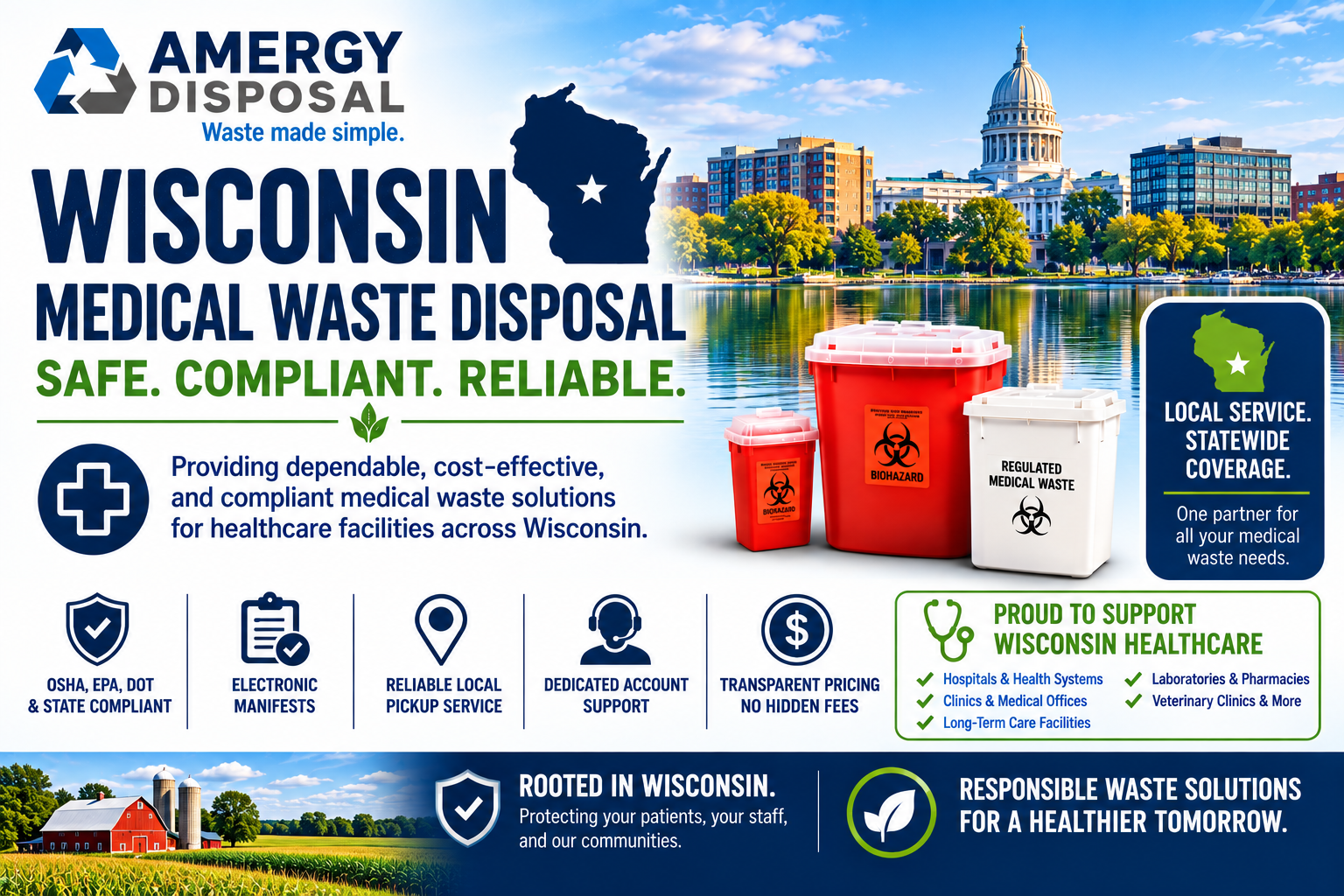
Wisconsin Medical Waste Disposal, Made Simple
Badger State providers are cutting disposal costs while tightening compliance. Here is how the savings work, what NR 526 actually requires, and where Amergy fits.
Wisconsin medical waste disposal does not have to strain your budget or your compliance record, and providers across the state are proving it every month. From Milwaukee hospital systems to small dental offices in Madison, businesses are rethinking who handles their sharps, red bags, and pharmaceutical waste. Moreover, they are switching to a partner that keeps them compliant and cuts their bill at the same time. That partner is Amergy Disposal. Below, we break down the savings, the state rules, and the exact steps that keep a Wisconsin facility inspection-ready all year long.
Wisconsin manages this waste stream through the Department of Natural Resources under Chapter NR 526. Notably, Wisconsin draws a clear legal line between “infectious waste” and “medical waste.” Consequently, the rules here differ from federal-only guidance and from neighboring states. Therefore, working with a hauler that knows Wisconsin specifically matters. Request a free quote and we will map your facility to the right service plan.
Key Takeaways
- The Wisconsin DNR regulates medical and infectious waste under Chapter NR 526 of the Administrative Code.
- Transport less than 50 pounds of untreated infectious waste per month and you skip the transporter license and manifest. At 50 pounds or more, both apply.
- Untreated infectious waste is banned from Wisconsin landfills. It must be treated first.
- Many medical facilities must run a waste audit and keep a written medical waste reduction plan.
- Businesses that switch to Amergy typically save 30 to 40 percent versus legacy haulers.
The bottom lineHow Wisconsin Businesses Are Reducing Their Spend
First, look at where the money goes. Most Wisconsin facilities overpay because their old contract is loaded with hidden fees. Fuel surcharges, “environmental” fees, automatic price hikes, and long lock-in terms quietly inflate the monthly invoice. Amergy strips those out. As a result, businesses that switch to Wisconsin medical waste disposal with Amergy commonly see 30 to 40 percent off their prior bill.
Furthermore, the savings go beyond price per pickup. Right-sizing service is the bigger lever. A rural clinic paying for weekly stops might only need service every other week. Meanwhile, a growing surgery center might need larger containers instead of more frequent visits. Amergy audits your actual volume first. Then we build a route and container plan around it. In short, you pay for what you generate, not for what a legacy hauler wants to sell you.
Above all, transparent pricing builds trust. Every Amergy agreement spells out the cost up front. There are no surprise line items, and there is no aggressive auto-renewal trap. See transparent pricing →
Who generates the most10 WI Businesses That Produce the Most Medical Waste
Some facilities generate far more regulated waste than others. Naturally, those businesses also stand to save the most by switching. Below are ten common Wisconsin waste generators, along with illustrative monthly savings ranges after moving to Amergy. Specifically, these figures reflect typical reductions against inflated legacy contracts. Your exact number depends on volume, location, and pickup frequency.
| WI Business Type | Why Volume Runs High | Est. Monthly Savings |
|---|---|---|
| Hospitals & health systems | Round-the-clock care across many departments | $1,200 – $4,500 |
| Outpatient surgery centers | High procedure counts and heavy sharps use | $700 – $2,400 |
| Dialysis clinics | Daily treatments generate constant bloodwork waste | $600 – $2,000 |
| Nursing & long-term care | Ongoing resident care and sharps volume | $500 – $1,800 |
| Blood banks & diagnostic labs | Specimen and culture waste at scale | $500 – $2,200 |
| Physician group practices | Multiple providers and daily injections | $200 – $900 |
| Pharmacies & retail clinics | Expired drugs and immunization sharps | $200 – $800 |
| Dental practices & DSOs | Sharps, amalgam, and daily clinical waste | $150 – $700 |
| Veterinary clinics | Surgical, sharps, and pharmaceutical waste | $150 – $650 |
| Tattoo & body art studios | Needles and blood-contact materials | $80 – $300 |
Figures above are illustrative ranges for planning only. For a number built on your actual volume, get a free Wisconsin quote.
The rulebookWisconsin Medical Waste Laws and Regulations
Wisconsin governs this waste stream through Chapter NR 526 of the Wisconsin Administrative Code, titled Medical Waste Management. Notably, the Department of Natural Resources administers the program. Additionally, the rule covers source separation, containment, storage, transport, treatment, disposal, and recordkeeping. Together, these requirements shape how every provider handles Wisconsin medical waste disposal.
Infectious waste versus medical waste
Wisconsin uses two terms that sound alike but are not. Specifically, “infectious waste” is the regulated stream, such as sharps, blood, and lab cultures. Meanwhile, most other clinic trash counts as “medical waste” only if a generator mixes it with infectious waste or manages it as though it were. Therefore, good separation keeps your regulated volume low and your costs down.
The 50-pound threshold
The key number in Wisconsin is 50 pounds per month. A generator that transports less than 50 pounds of untreated infectious waste off-site each month is exempt from manifesting and from holding a transportation license. However, at 50 pounds or more, both the manifest and the infectious waste transportation license apply. Consequently, knowing your monthly volume matters.
Source separation, treatment, and disposal
First, source separation is mandatory for all non-household generators at the point where waste is created. Second, infectious waste must be treated before disposal. In fact, no one may send untreated infectious waste to a Wisconsin solid waste facility. Generators may treat their own waste if they follow the rule, while anyone treating more must obtain DNR approval and a license. As a result, your treatment path needs to be documented.
A note on federal rules
State rules sit on top of federal ones, not instead of them. As a result, Wisconsin generators also follow OSHA’s Bloodborne Pathogens Standard, DOT hazardous materials rules for transport, and RCRA rules for any waste that is also hazardous. Amergy builds all of these into one compliant program. Learn more about our compliance services.
Wisconsin specificsState-Specific Medical Waste Requirements in WI
Beyond the basics, Wisconsin asks for something many states do not. Specifically, under NR 526 Subchapter III, many medical facilities must perform a waste audit and keep a written medical waste reduction plan. The goal is to cut total waste and prevent non-infectious trash from being mixed in. Additionally, generators that are required to manifest must also file annual infectious waste reports with the DNR.
There are a few more Wisconsin details worth noting. For instance, off-site shipments that cross the 50-pound line use the state infectious waste manifest, DNR form 4400-176. Furthermore, on-site treatment facilities that handle less than 500 pounds per day follow a lighter regulatory path than larger operations. Meanwhile, home generators are fully exempt from the chapter. Amergy trains your team on each of these Wisconsin-specific points, so there is no guesswork.
Your compliance partnerHow Amergy Keeps WI Businesses Compliant
Compliance is more than a pickup. Therefore, Amergy delivers a complete program built around Wisconsin rules. To begin with, every customer gets compliant containers, correct labeling, and scheduled service sized to their real volume. Then we handle the manifests and treatment certifications that prove your waste was treated before disposal.
Moreover, Amergy provides OSHA and bloodborne pathogen training for your staff, along with the exposure control plan templates inspectors expect to see. We can also help larger facilities keep their waste audit and reduction plan current. Consequently, your NR 526 paperwork stays in order. Above all, you get a single point of contact who knows the state, so questions get real answers fast. Explore our medical waste services →
Your Online Safety & Compliance Portal
Every Amergy customer gets access to a secure online Safety and Compliance Portal at no extra cost. Instead of digging through a filing cabinet before an inspection, your documents live in one place. As a result, a Wisconsin inspection becomes a quick login rather than a scramble.
- On-demand manifests and treatment certifications
- Annual infectious waste report records
- OSHA and bloodborne pathogen training logs
- Waste audit and reduction plan support
- Downloadable exposure control plan templates
- Service history and upcoming pickup schedule
Statewide coverage20 WI Cities Where Amergy Keeps Customers Compliant
Amergy serves generators across all 72 Wisconsin counties. In particular, we support customers in the state’s 20 most populous cities, listed below. Wherever your facility sits, we route service to it. Check availability for your address →
Know who to callWisconsin Regulatory & Business Contacts
Keep these Wisconsin contacts handy. For instance, the Department of Natural Resources runs the medical waste program directly, while the Department of Health Services covers broader public health questions. The Greater Madison Chamber of Commerce is a useful local business resource in the capital region.
Wisconsin DNR
Medical Waste ProgramBureau of Waste & Materials Management
1-888-936-7463
Madison office: (608) 266-2621
WI Dept. of Health Services
Public Health201 E. Washington Ave., Madison, WI 53703
(608) 266-1865
TTY: 711
Greater Madison Chamber
Local Chamber of CommerceMadison, WI
(608) 256-8348
Business support & networking
Phone numbers are provided for convenience and can change. Please confirm current details on each agency’s website before you rely on them.
Quick answersWisconsin Medical Waste Disposal FAQ
Who regulates medical waste disposal in Wisconsin?
The Wisconsin Department of Natural Resources regulates infectious and medical waste under Chapter NR 526 of the Wisconsin Administrative Code. The Department of Health Services handles broader public health matters.
What is the 50-pound rule for medical waste in Wisconsin?
A generator that transports less than 50 pounds of untreated infectious waste off-site per month is exempt from manifesting and from holding an infectious waste transportation license. At 50 pounds or more per month, both the manifest and the license apply.
Does Wisconsin require a medical waste reduction plan?
Yes. Under NR 526 Subchapter III, many medical facilities must perform a waste audit and keep a written medical waste reduction plan. Smaller facilities below the threshold may be exempt but must still track their waste volume.
Can you throw medical waste in the trash in Wisconsin?
No. Untreated infectious waste cannot go to a Wisconsin solid waste facility. It must undergo approved treatment before disposal under NR 526.13. Amergy handles that treatment path for you.
How much does medical waste disposal cost in Wisconsin?
Cost depends on waste volume, location, and pickup frequency. Wisconsin businesses that switch to Amergy Disposal commonly save 30 to 40 percent versus legacy haulers. A free quote gives you an exact figure.
Badger State trivia6 Wisconsin Facts on Medical Waste
Wisconsin runs its medical waste program through the Department of Natural Resources, not a health department, which surprises many new generators.
Transport under 50 pounds of untreated infectious waste a month and you skip the transporter license and manifest. Hit it and both kick in.
Wisconsin separates “infectious waste” from “medical waste.” Most clinic trash is not legally infectious unless it is mixed with infectious waste.
Many Wisconsin medical facilities must run a waste audit and keep a written reduction plan, a sustainability mandate most states skip.
Untreated infectious waste is barred from Wisconsin landfills. It has to be treated before it can be disposed of.
On-site treaters handling fewer than 500 pounds per day follow a lighter regulatory path than larger facilities.
Get Your Free Wisconsin Quote
See exactly how much your facility can save on Wisconsin medical waste disposal. No obligation, no hidden fees, and a plan sized to your real volume.
Request a Free Quote Call (877) 263-7491Bringing it togetherWI Compliance and Savings, Handled
The savings are real and measurable
To sum up, Wisconsin businesses are cutting 30 to 40 percent off legacy disposal bills by switching to Amergy. Because pricing is transparent and service is right-sized, the savings hold up month after month. Ultimately, that money stays in your practice.
The rules are specific to Wisconsin
Meanwhile, the state’s NR 526 rule carries its own thresholds, manifest, and waste reduction steps. Consequently, a partner who knows Wisconsin keeps you out of trouble. Amergy tracks your manifests, treatment records, and reduction plan so nothing slips.
One partner covers it all
Finally, Amergy pairs compliant Wisconsin medical waste disposal with an online Safety and Compliance Portal for every customer. As a result, your next inspection is a login, not a fire drill. Contact Amergy for your free quote →